
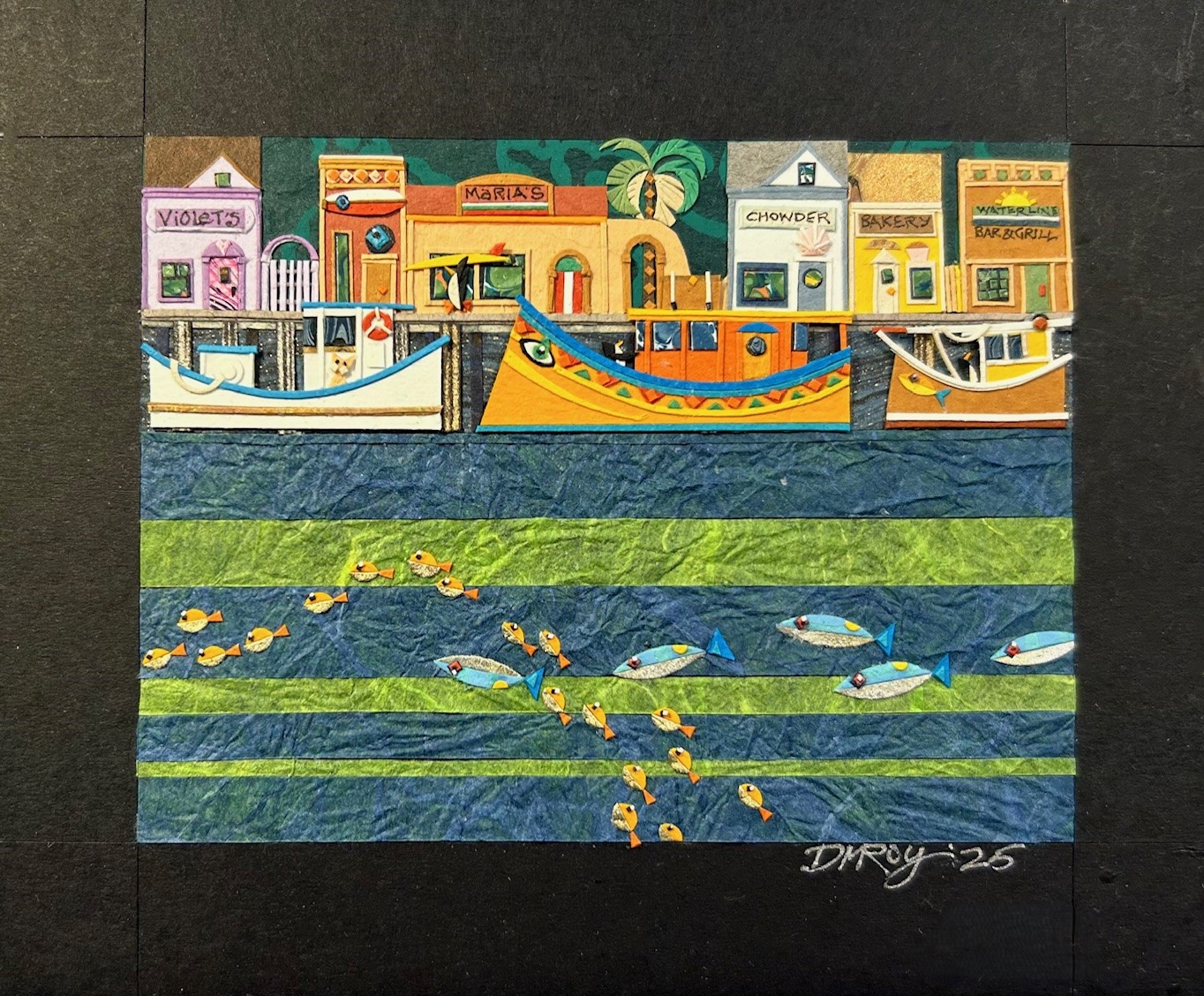
 Doug Roy, Waterline, Cut Paper
Thebes, First Day of Summer
In the hour of treason / The landscapes are beautiful.
Heiner Müller, “Motiv bei A.S.”, Ende der Handschrift. Suhrkamp: Frankfurt am Main, 2000.
My translation.
As you are waiting in the poorly watered park for the demo against one empire,
And only for certain victims,
The tragic choice between ideals foreign to them, the believers in wishes,
In the one good packing all deities in good harmony,
Neither theirs nor yours giving any shade (note to self: water the bougainvillea).
Yet, because it’s summer, you are thankful to these monotheists who keep you sharp,
For your lawn is green, Celibidache conducts, the purple allium blooms,
The gecko ate its own shed skin, nothing useless left behind, rewarded with water to lap.
Later, at night, in bed, exhausted,
Though you got a meal, and no bomb has fallen on your apartment,
You review the order between your particle and the world,
How tomorrow morning will be just another half treason of all those we commit,
For all to see and ignore, panorama of all the things that want to be, and fail,
You as well, and the light all over it.
_________________
Massimiliano Nastri
Review by Jared Pearce
The chores and maneuvering of the speaker allow both the humdrum, the despair, and eventually the joy of living, presented clearly and carefully.
Review by Manny Blacksher
Massimiliano Nastri’s “Thebes, First Day of Summer” is ‘narrated’ in second-person: I/we are its speakers and its subjects. I think the “Thebes” referred to in the title is in some ways the legendary Grecian city-state Sophocles sets his tragedies in. I think especially of the crises that inform Antigone.
In Sophocles’ tragedy, Antigone fights to have her defeated brother’s body decently buried. Her brother Polynices rebelled against their eldest brother to capture the monarchy. Both brothers were killed in the civil war. Thebes’ new king, Creon, Antigone’s uncle, has publicly condemned Polynices as a rebel and regicide, and Polynices’ body has been left outside Thebes’ walls to rot and be scavenged. For Polynices to have rebelled against the king and killed his brother was both regicide and fratricide, crimes against both the state and the sacred integrity of the family. Antigone contends that, in forbidding his nephew’s burial, Creon, has disgraced his family and deprived the unburied nephew of the most basic recognition of his human dignity. Antigone fights her uncle to have her brother buried out of love for the dead man, but also with the aim of saving some of her family’s remaining honor and sanctity. Ultimately, she dies proving her devotion to her brother and her family but acting contrary to the decrees of the king, the city’s laws, and the gods’ condemnation of an impious insurrectionist.
In Nastri’s poem, ‘I/you/we’ clearly inhabit a modern urban now, so the Thebes in the title is a metaphorical or ‘spiritual’ Thebes, the ‘kingdom’ of our predicament. Like characters in Antigone, we’re all born a society governed by multiple orders of authority that, we learn, it’s our duty to obey and venerate. A conundrum of our ‘freedom’ is that by devoting ourselves to supporting some sovereign orders that we esteem—self-autonomy, the family, our commitment to religion and to conscience, to property rights, to local government, to the nation, to a united humanitarian world, and to a revered planet—we neglect or defy responsibilities to other primary goods. Perhaps we might refuse compromise and resolve to only honor authorities we’re fully committed to (and so preserve our self-integrity), but every hierarchy and empowered community we publicly withdrew our assent from is one from which we’d be ‘banished’ as dissenters. In defying one system, we must consider whether we’re betraying values integral to another order that we do claim to honor and protect.
Nastri indicates that our good, civil, representative-democratic societies (when they’re working well) aren’t geared towards punishing rebels but to enjoining all of us to consent to the inherent goodness of all our shared public orders and institutions. Usually, we’ll affirm that we don’t live under tyranny: an oppressive rule in which compliance with orders of authority is actively, violently enforced. Instead, we live in hegemonies, systems of interconnected social orders in which our assent and compliance are assumed. Implicitly, Nastri suggests that, if we’re honest, we must concede that by upholding any one system’s overarching values we often diminish or undermine the authority of others.
Nonetheless, we struggle to protect ourselves from the accusation that we’re rebels, even though that means we’re not completely honest. With moderately clean consciences, we participate with others in inclusive celebrations of the good orders we’re all supposed to submit to, though, quietly, we dissent from some values and laws. We’re all “traitors” deep down, especially when we get out and demonstrate with our civic family of citizens to show our devotion to every system of authority we ought to be obeying without exception.
And the cognitive dissonance of knowing we’re good and upstanding, while also confiding that we’re not standing up for everything—and in private we’re really opposed to things we believe are illegitimate . . . the deep-down feeling that we’re secret ‘traitors’ gives our lives a special sweetness and aesthetic beauty that comes from precarity. We’re aware that, if a major religion, the local patriotic militia, or state government were sweeping up all the ‘fakers’ and believers-in-name-only, we’d probably be convicted and sent to the reeducation camps. The proof of our secret exceptions would be there for our neighbors to testify to, but then everyone else would have their own authorities they are inconsistently devoted to.
It’s a terrible given that our ‘good’ societal orders each have particular groups of scapegoats whom we’re supposed to despise. If it were commonly known that we empathize with the persecuted, our heretical sympathies might get us sent to the countryside to work the Authentic People’s good soil or might make it we who get the “bomb [fallen] on [our] apartment.” The epigraph from Heiner Müller speaks of “landscapes” made more delightful because they could be taken. “Landscape” could also signify a broad ‘vista’, a way that we see all the nice things together when we’re not having to look too closely at the particular things that trouble us, that we dissent from.
The poem begins with ‘us’ standing with other ‘we’s waiting to participate in a peaceful “demo,” a ‘demonstration’ against the things in our landscape that aren’t right. But we’re all able to stand with each other in a safe demonstration because we’re aware of places and times and peoples (people like us) who were or are seeking cover from violent, murderous “demo”-‘demolitions’ of their entire landscapes and civic vistas. We might even be aware that our freedom to demonstrate in public is built on the understanding that our orders of authority must persecute and scapegoat other groups. We’re never demonstrating against the persecution of all victims.
Nastri’s poem ultimately calls us away from pleasantly recognizing the nice things that come to us in the package we obtain by colluding with orders of authority we might not truly agree with. However, he notes, among us there are still people simple or zealous enough not to feel the incoherence of their convictions but who believe rather all worthy things in our society must be parts of a single, unified, coherent system of values. These are his “monotheists” who keep us—we who know ourselves to be peaceful, amiable “traitors” and polytheists—“sharp.”
Nastri concludes with a harsh recognition that tonight we privately “review the order between [my/our] particle and the world” and acknowledge that, if we were more devoted to inclusive goods, we might rebel and follow through with secret convictions that we should be better than we are, and we ought to be making a world that’s not, for most others, “poorly watered.” Thinking of a better world, we’ll sleep well. Tomorrow will be bright with summer sunshine, in which, for all to see, we’ll continue with our “half treason” in never really trying to square the narrow myopia of our little ‘harmless’ selfishnesses and inconsistent courage and willingness to “ignore” what’s known by everyone to be ‘messed up’ with the grand but sad “panorama of all the things that want to be, and fail.” As we daily acquiesce as traitors to the reality that some good things inevitably fail, we sense that what’s ‘good’ and ‘visionary’ in each of us must be counted among the things we’re doomed to try, with more or less fervor, to foster until we fail.