
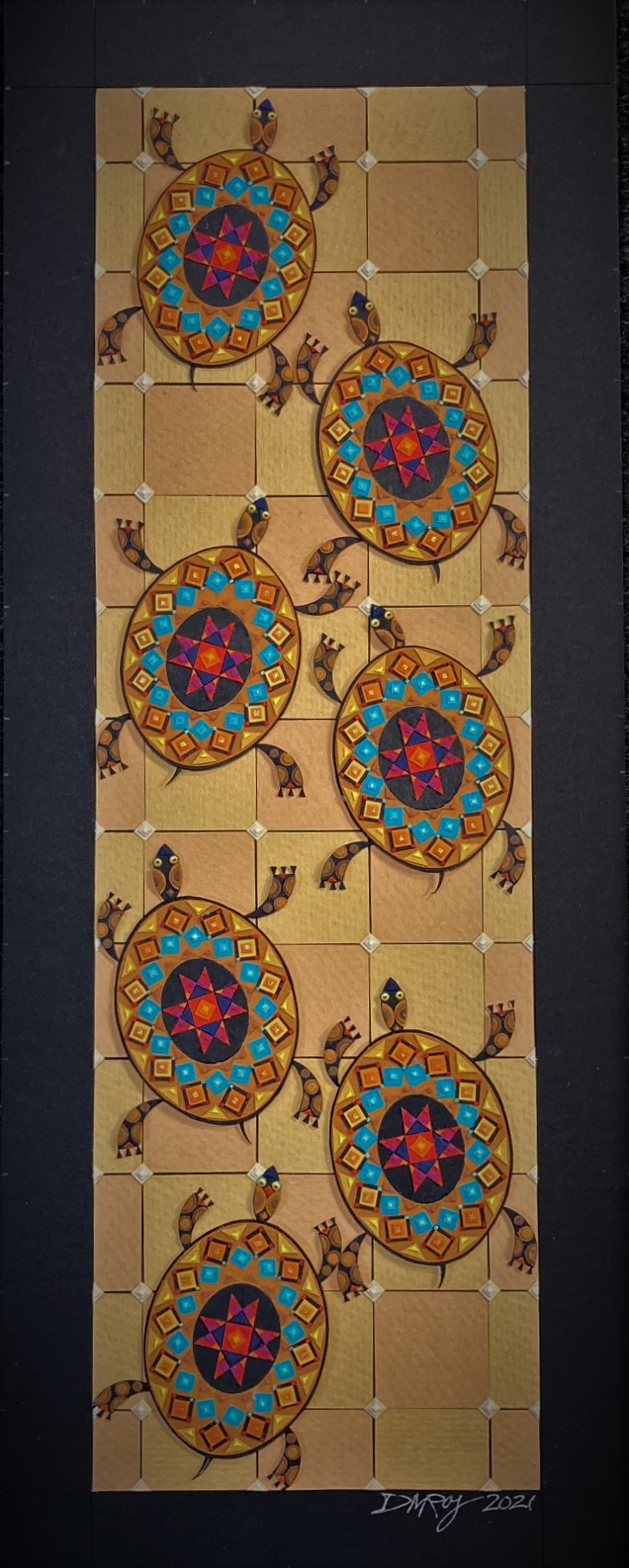
 Doug Roy, Turtles, Cut Paper
Because a Woodchuck Looks like a Rock
Only at certain times of day
and only when viewed
at a certain angle
and only in a certain frame of mind
do I see the rock
that looks like a woodchuck
and sometimes the cloud
that summons an elephant
a crack in the ceiling
can look like a spider
a hair on the mirror
mimic a crack
a box can be empty
a door can be locked
the next step can be tricky
because when alarmed
a woodchuck can look like a rock.
____________
Philip Kirsch
Review by Bruce Parker
Well done, tight, reflection on nature and chance.
Review by Carol Casey
A clear and imaginative portrayal of things aren’t always what they seem- the mysterious nature of life.
Review by Jared Pearce
You know, for me, the older I get, the more of these correspondences I perceive and, frankly, worry me sometimes. Thus, the alarmedness noted by the speaker near the end of the poem held a particular poignance.
Review by Manny Blacksher
I think Phil Kirsch’s “Because a Woodchuck Looks Like a Rock” is beguilingly funny. As a reflection on ways in which things appear to us, it’s also provocative. It notes some of the conditions required for us to we recognize things we’d call ‘familiar’. As much as we’re inclined to agree with the narrator’s commonsensical statements, there are moments when the poem nudges us to re-see ordinary things with fresh expectations, and we balk at the thought that normal things could be other than what we expect.
The poem’s first stanza’s eight lines long, it’s second nine. Line lengths are roughly similar. The stanzas mirror each other. The first observes the circumstances that pertain to our “see[ing] the rock/ that looks like a woodchuck.’ The second stanza abruptly concludes with a kind of prestidigitation. The poetic persona advises us, finally, that what follows from our less confident way of seeing things “can be tricky/ because when alarmed/ a woodchuck can look like a rock,” of the perspective in the first stanza.
The poem doesn’t claim that rocks and woodchucks are the same things or that they can substitute for one another. Rather, they’re so different, it’s a wonder that we could mistake the appearance of one for the other. ‘Pareidolia’ is our tendency to see likenesses in random appearances: to recognize pictures in clouds, a face in the moon, a vast countryside in the way our unfocused eyes interpret the surface of a bedspread or a span of tiled floor. Pareidolia was a evolutionary adaptation that allowed us to quickly identify threats in ambiguous terrain. As we became less threatened by the chance that a lion might crouch concealed in long grasses, the inclination to see familiar things in random appearances became an element of our visual-cognitive creativity. We know there are circumstances— “viewed at a certain angle/ . . . in a certain frame of mind” —when we suspend skepticism and let ourselves see things that aren’t there or allow things to appear to be what they aren’t.
It’s possible that misleading appearances can become so familiar in cultural contexts that ‘misapprehended’ things take on their own figurative-metaphorical conventionality. If somebody tells us they see the face of the man in the moon, we accept that it’s traditional to look for and see a face in the moon’s features. The poem’s narrator suggests that, in one frame of mind, we might well behold a “cloud/ that summons an elephant,” and within traditional Hindu culture the massive clouds are associated with the god Indra’s celestial mount “’Abhra-matanga’, meaning ‘elephant of the clouds’.”[1] So within one culture, in a metaphorical sense, it’s not unusual for some cloud formations to “summon” illusionary elephants; it’s allowed that some clouds look like an elephant because metaphorically they are Indra’s elephant.
Kirsch builds a sequence of believable statements about wishful recognitions and mistaken apprehensions into propositions we’d accept as valid, normal. In the second stanza, it intrigues me that, after suggesting two situations in which appearances mislead, the persona names two new situations that, it’s implied, we also ought to treat suspicion, though we’d say there’s nothing peculiar about them: “a box can empty/ a door can be locked”. Why do this? I think of two possibilities. One is that we have ‘normal’ functional expectations about these objects that can be disappointed. We’d say, ‘Boxes are made to hold things’, but a box might be empty, just as doors are entries that, once opened, let us through, except for when we find a door has been locked. We don’t usually feel like we’ve been misled or fooled if we find an empty box or discover a locked door won’t let us through.
Another way to look at the box is to argue (thinking about misapprehensions and unexpected statements in poems) that even ‘empty’ boxes contain things: dust, air, darkness, space . . . If we had to imagine what could be misleading about a locked door, we might say, ‘Doors by their very nature always offer ingress and egress, but doors can also have locking mechanisms that limit or prevent passage. Some doors stay locked; we can only ever imagine them open.
So when the narrator suggests something’s “tricky” about the last resemblance, he might be suggesting that an “alarmed” woodchuck immobilized, camouflages well with rocks. Or the persona might be claiming that when we are “alarmed,” when our imaginations are excited, a woodchuck could look like a “rock” or any of a number of other things. In that sense, we could say that “resemblance” isn’t in the shape and color of a woodchuck but in the excitement of the spectator (or predator). And poems are an occasion in which induced excitement allows firm expectations to be confounded. Slippery, figurative language’s effects are the “tricky” parts that force us to concede that things aren’t—and maybe we aren’t—what we suppose.
[1] “Airavata,” Wikipedia entry (06/18/26): < https://en.wikipedia.org/wiki/Airavata >
Review by Dave Mehler
I think what Kirsch is up to here is the phenomena of pareidolia, and atavistic animal instinctual fear. My guess is the poem has to do with how our brains are wired to see patterns and quickly recognize threats like snakes which might lunge out of shrubbery and deal us a deathblow. Also something philosophical perhaps about how we use patterns and stories to make meaning of our lives? It’s a poem about perception and misapprehensions in how we perceive the world, then test our perceptions to judge what is real and what is only imagined? Isn’t this ability the distinction between the sane and the insane? Questions are raised: Do our perceptions form or respond to reality? Because we are bound inside our heads, can we ever know or trust that an objective reality exists outside our perceptions? Is there any way to get outside those heads to verify reality? It’s true we can photograph or hold up a mirror to a landscape, but we still must view and interpret what we see. I think Phil’s way of dealing with this dilemma is through these remarkably compressed two lines: a box can be empty / a door can be locked. To me to raise the issue and then deal with it with this kind of brevity is nothing short of brilliant. Another clever and interesting thing to note about the poem is the inversion from ‘woodchuck looks like a rock’ in the title to the ‘rock that looks like a woodchuck’ in the poem’s opening, and then ending on ‘woodchuck can look like a rock’ again in the final lines. The reader is left with mystery–which thing was real and the other an illusion? Wittgenstein could go mad over stuff like this.