
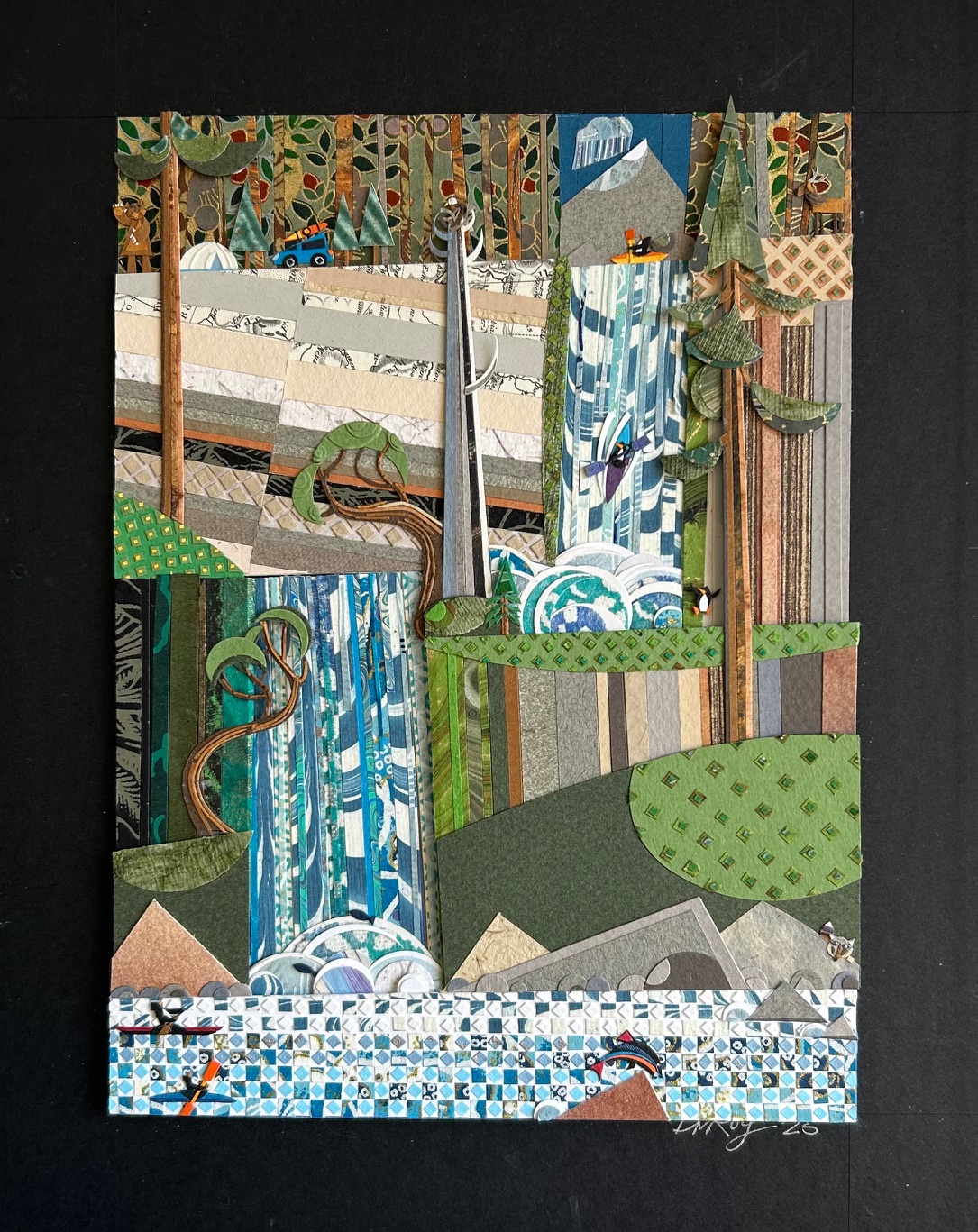
 Doug Roy, Over the Falls, Cut Paper
“In der Zeit des Verrats / Sind die Landschaften schön.”
IV. Must we have a future?
Mouches de mes soleils noirs / […] /
Partez, petits désespoirs, /
Petits espoirs, douleurs, joies.
Verlaine, Jadis. Prologue
Can’t we seize joy, our hopes, our despair relevant as flies?
If you measure these things, the sun will be exactly there, again,
And under it, this roof, and under it, us – again – or people like us.
Civil wars are being fought between clouds, between elements,
But we may stop agonizing over what endless nights would get us,
As though we could buy the stars at the market, today, tomorrow and …
Species, singers and women are still being murdered,
Yet, there’s a respite here no god could ever dream,
A shift from metaphysics to mediocrity, the wallpaper of private days,
What revolutions and constitutions should promise: be at peace with
This miracle of nothingness, learn from the indifference of light
And the empty spaces around it, to mean something between them,
And let it go, collect the darkness we have been paying for all this time,
And, like the shadow of a caress over your skin, kiss, as the eclipse is doing.
____________________
Massimiliano Nastri
Review by Ben Sloan
The evocation here, for me, is the tension I, maybe others, feel between the sameness of daily life–”the wallpaper of private days”–and the pursuit of, the hope for, something more–a world where “we could buy the stars at the market, today, tomorrow and ….”
What I see Nastri suggesting is that the answer is right in front of us, in the in-between spaces–that, as Wittgenstein puts it, “the aspects of things that are most important for us are hidden because of their familiarity and simplicity.” Putting it his own way, Nastri suggests we “learn from the indifference of light / And the empty spaces around it, to mean something between them.”
There is something about how our minds tend to want always to see things as part of an either/or split–the distinction between “metaphysics” and “mediocrity”–but in fact there is something else available, if we will only allow ourselves access to it, an in-between space where, if we allow ourselves to “let it go”–let go, that is, of our usual way of seeing our place in the world, our habitual way of seeing and experiencing the world around us.
We have right before us everything for which we have been hoping, searching–if we would only allow ourselves to see it. Massimiliano Nastri’s poem is a guide, a finger pointing us in the right direction. I love the opening quote. Translated, it means “In times of betrayal / the landscapes are beautiful.”