
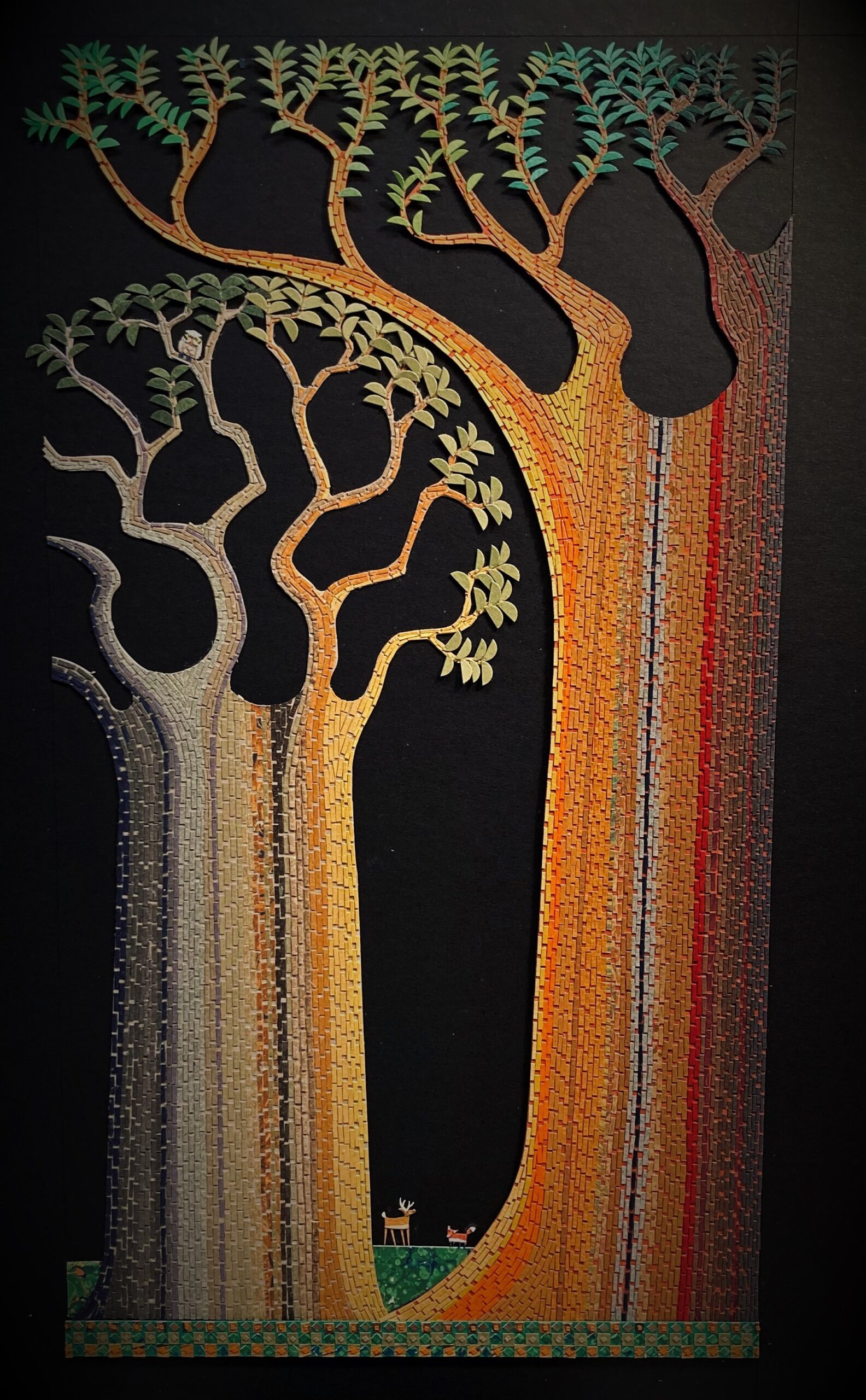
 Doug Roy, Two Trees, Cut Paper
Impression of Pueblo Bonito, 2025
Maybe she’s a hoarder, but she hoards interesting things
that are her stock in trade,
antiques often otherwise referred to as junk:
a chair with a portrait of a lion with a cigar in its mouth on the back,
gold dial telephone, mismatched chairs, old carpets,
a ceramic eighteenth century boot beer stein,
table lamps circa 1925 with shades of colored glass inlaid flowers
adorned with fringes of jet or crystal,
a torn scotch-taped yellowed copy of a book of
short stories by Truman Capote.
I coveted the impression stamped into a big sheet of sand-colored paper
of the layout of Pueblo Bonito framed under glass,
the impression so good I could single out Room 28
where archaeologists found cylindrical ceramic jars
with traces of cocoa imported from before there was a Mexico,
but no sign of damage from the 1941 fall of Threatening Rock.
Her brother bought the impression, like a big letterpress job,
in the gift shop there at the historical park.
When I visited her it was there all along
behind the rump-sprung comfy dull red chair
I was sitting in. I don’t remember any gift shop,
it was nine years ago. When she showed it to me,
I wanted to buy it from her,
but it was a family relic with a story behind it,
not for sale.
_____________
Bruce Parker
Review by Ben Sloan
This poem invites us to consider how we come to know another person based on clues available, maybe, in the rooms of their house, the things they say to us in those rooms, and hints we might gather in this way. Here we have a woman who has an idiosyncratic collection of odd items–including an impression of Pueblo Bonito, a popular archaeological dig site. Inside Pueblo Bonito are many rooms, room 28 mentioned here, continuing artifacts of a past civilization: mentioned are “cylindrical ceramic jars / with traces of cocoa imported from before there was a Mexico.” So in our minds we can go into these previously hidden, now exposed rooms and–again, in our minds–handle the artifacts found there. Isn’t the way we come to know people much the same way? The room the author is in, belonging to the unnamed woman, is analogous to the Pueblo Bonito, containing artifacts that give us clues about the person living there (having lived there in the case of Pueblo Bonito). With work and careful digging we can, if we want, if it matters to us, come to know one another–but we have to be respectful, work to avoid damaging what we find within the rooms that are the people around us.