
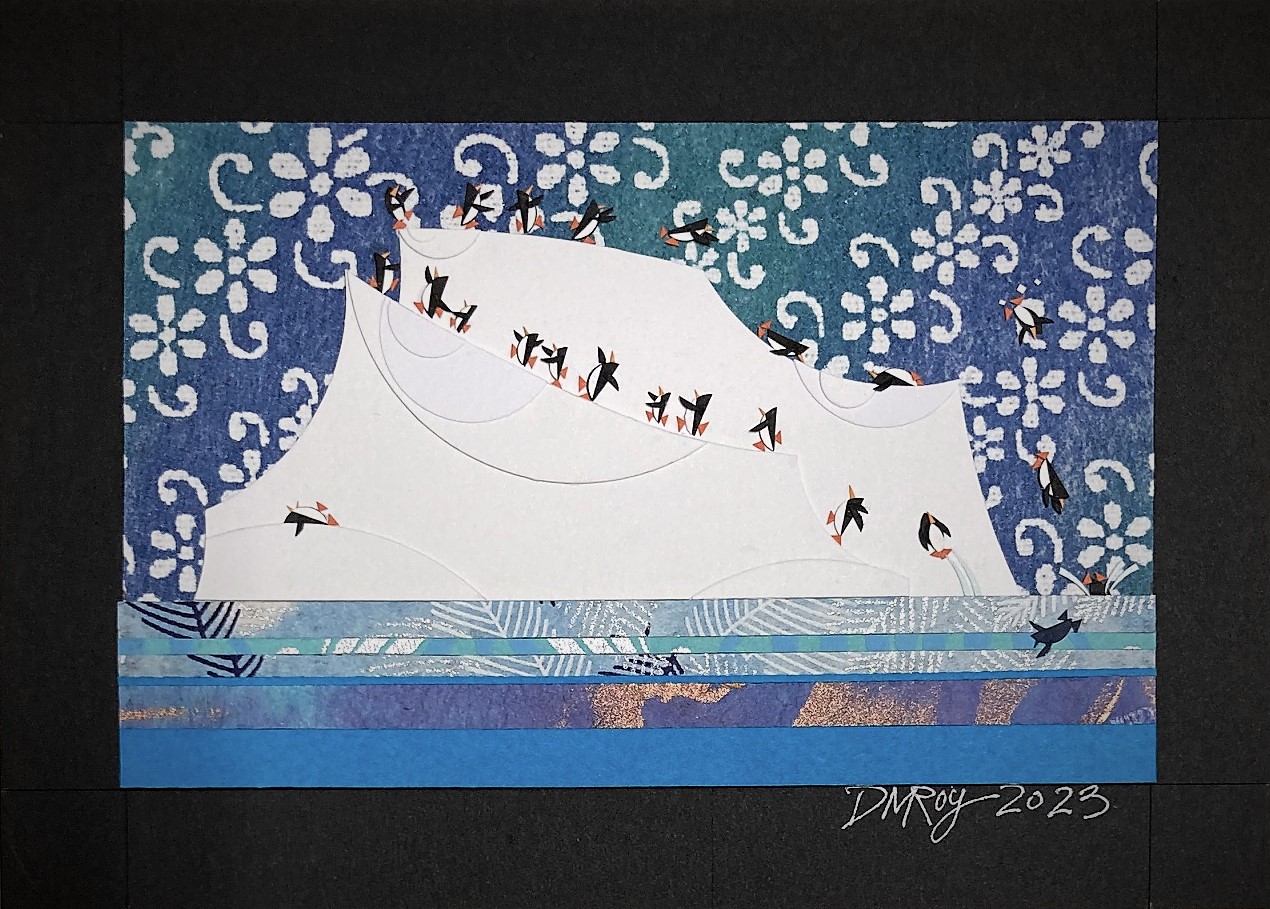
 Doug Roy, Penguin Play Day, Cut Paper
My Holding
after Lisa O’Neill
I don’t know how to tell you how I’m doing.
It seems there are no words that will suffice;
how much of this menagerie’s worth sharing—
this wild collaboration that’s my life.
I’d tell you that the loving is imperfect.
Yet then I’d have to tell you that it’s worth it.
And if you ask me why, well that’s the question
that spreads its seeds all over in my holding.
And if you ask me how it grows, I’d tell you
it grows with tears and blossoms into dance.
And I can touch it if I’m quiet and gentle.
And I can break it easier than that.
______________
Carol Casey
Review by George Freek
I don’t like to criticize other people’s poems. My favorite was Carol Casey’s ‘My Holding.’ Wonderfully understated, which made it all the more emotional. And it moved me very much, by it’s restraint.
Review by Jared Pearce
I admit I didn’t look up the O’Neill piece. I like the sounds of Casey’s well enough, the extended metaphor throughout, the near rhymes, the small meters. It’s a quiet poem that describes the trickiness of love and life that is, for me, best found in the final two lines.
Review by Ben Sloan
“My Holding” is first of all a celebration of the act of dialogue, its design built around answers to three questions, each answer leading to a new question and contributing to a deeper understanding of how the speaker is “doing.” It may be that the speaker has not actually been asked the second and third question, but just that the “How are you doing?” inspires an unexpressed meditation on what telling the truth might in fact involve.
Part of the beauty of the poem is the attempt to explain the hard-to-explain in one’s experience how “the loving is imperfect.” I am reminded here of the first line of Anna Karenina, “Happy families are all alike; every unhappy family is unhappy in its own way” in the way that for every person, probably, “the loving is imperfect” in one’s own unique way. But this is not a complete answer since next we learn that “it is worth it.” The interesting turn we take here is that were one to ask “why” it is worth it, the mere asking, the mere question itself, is what “spreads its seeds in my holding.”
The idea of “my holding” suggests how the speaker is in control, maybe while at the same time being out of control, however that might happen, since the seeds grow “with tears and blossoms into dance.” The idea of being in control while at the same time being not in control is suggested by the last two lines where one can “touch it if I’m quiet and gentle”–or “break it easier than that.”
Part of the pleasure of reading “My Holding” is following the variety of twists and turns as we accompany the speaker’s increasing understanding of themselves. At the same time we are increasing our own understanding of ourselves.