
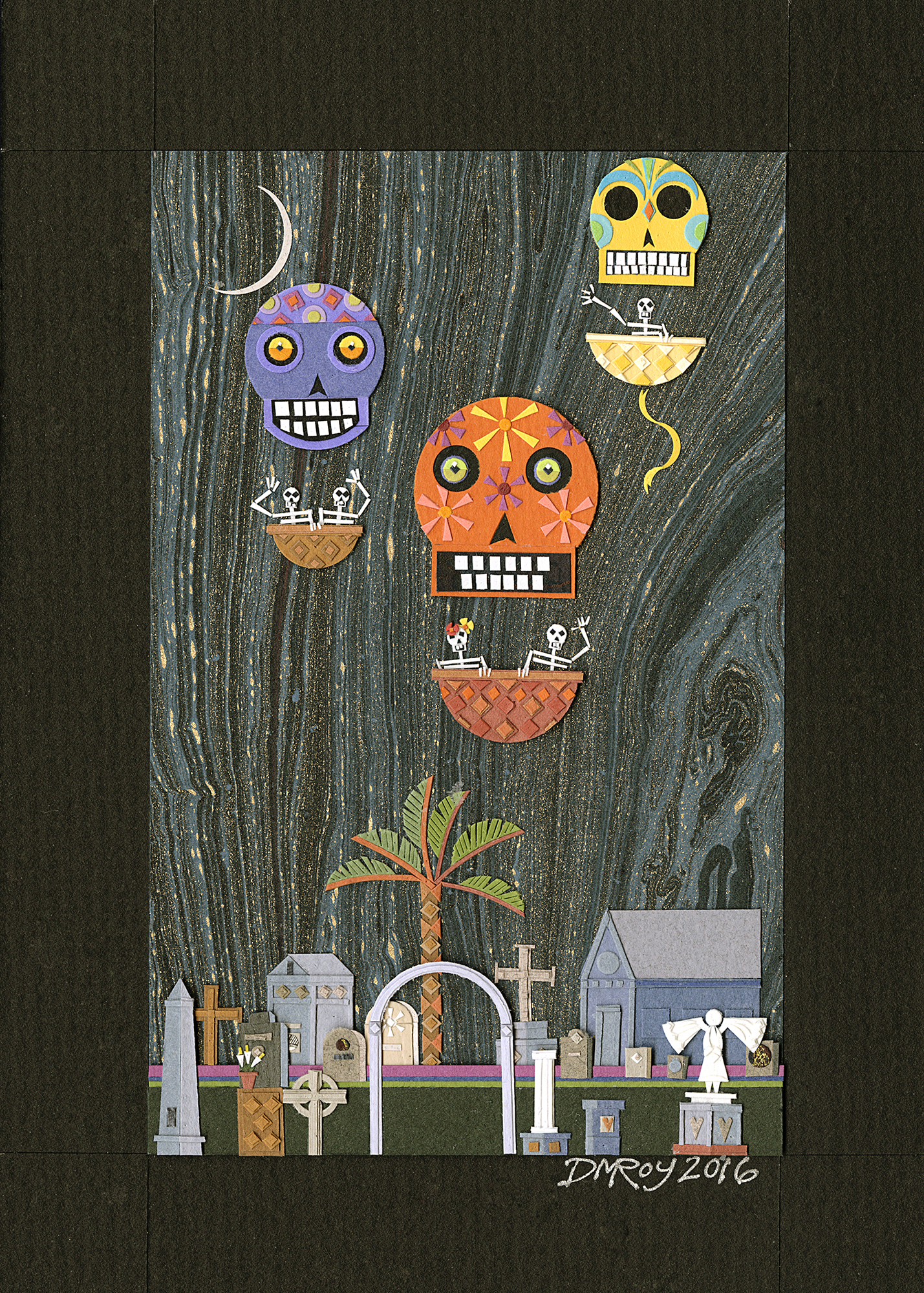
 Doug Roy, Day of the Dead, Cut Paper
Sun Dagger 1977
In 1977 Anna Sofaer visited Chaco Canyon,
a volunteer to record ancient rock art.
She climbed Fajada Butte, and on a high ledge
found three
large
stone slabs
leaned against the cliff,
which channeled light
and cast shadow
she named Sun Dagger.
The light illuminated two spiral petroglyphs
that wound around the sunlight
she studied through her next thirty years, where
the man had climbed high
to that natural ledge. There
he cleared and smoothed the rock face
and chipped the spiral with care.
His strong helpers shifted
the three slabs of stone which Anna found,
they spoke in what she calls millimeters, degrees, shafts
of light and shadow, following sun and moon
in their courses, sources of power and knowledge
of when to plant, when to reap, when to keep
their beams to foster life.
“We happened to get there near noon, a week from solstice, and a dagger of light was bisecting the spiral,” she said.
Her research has since determined
this Sun Dagger likely a calendrical shrine,
marking the sun’s varying heights at solstices and equinoxes,
and the moon’s rise over its 18.6 year standstill cycle,
oh, my.
Every two weeks the moon appears to stand still, every two weeks,
standstill: a state characterized by absence of motion or of progress
in 13.66 days.
One major, or one minor,
lunar
standstill occurs every 18.6 years.
Without calculators, computers, telescopes, astrolabes,
the elites paid attention to the moon and sun, to shadow angles
and made a dagger of sunlight
upon a spiral
on a rock face.
“We got this!” the man said
and climbed down with his helpers
from where the woman climbed up
at noon
just in time.
Perhaps with help from the south:
fourteen burials at the greatest house in the canyon center—
DNA OFFERS CLUES TO MYSTERIOUS CRYPT IN ANCIENT PUEBLO
in Room 33 in Pueblo Bonito
so named not by those who built it
but by those who first
looted
skeletons excavated more than a century ago
in a honeycomb of nearly 650 rooms was
a hidden chamber measuring just six feet by six feet
accessible only by a small hatch in the roof
in 1896 remains of 14 people buried
surrounded by stunning wealth
more than twelve thousand turquoise beads
a conch shell from the Pacific, wooden flutes, cylindrical cups
containing traces of cocoa
and in Room 38, fourteen macaw skeletons
bred locally
the men and women there all related through their mothers
the DNA in a spiral from body to body
(their bodies in better health and physique than those
of the farmers who worked and lived across the canyon
whose children suffered more illness and lived shorter lives
than these whose stunning wealth echoed
down the centuries).
ARCHAEOLOGIST: “They may not all have been rulers, but they were related.
The evidence suggests it’s a long matriline, in control
for a long time.”
Burial 14, who died around 880 A.D., clues seem to indicate
the founder of a political dynasty that lasted 300 years or more
archaeologists took the remains to the American Museum of Natural History in New York City
where Burial 14 and her descendants were left another century
descended from the same maternal ancestor.
From the earliest days of its founding
the spiraling group circled the farmers
with their control of ritual practices
perhaps brought from the south in the Ninth Century
by men called ambassadors, traders, even spies.
However it came to them
the builders planned and constructed, in stages
over more than three hundred years,
buildings aligned with the cardinal directions,
most of all with North, the abode of spirits.
Their great buildings were aligned with each other,
and they scraped causeways for processions,
for the ancestors, the dead, the newborn, the animating
spirits of mountains, for the recursive cycle of seasons
and movement of moon and sun, for those to guide the people
in life day after day, from their emergence from the North
to their return.
_____________
Bruce Parker
Review by Jared Pearce
The stories, as they turn into the story, is a fine reminder of what and who we are. While I don’t know that the definition is needed except by way of emphasis or by way of luring the reader to that theme that seems to lie just below the surface.