
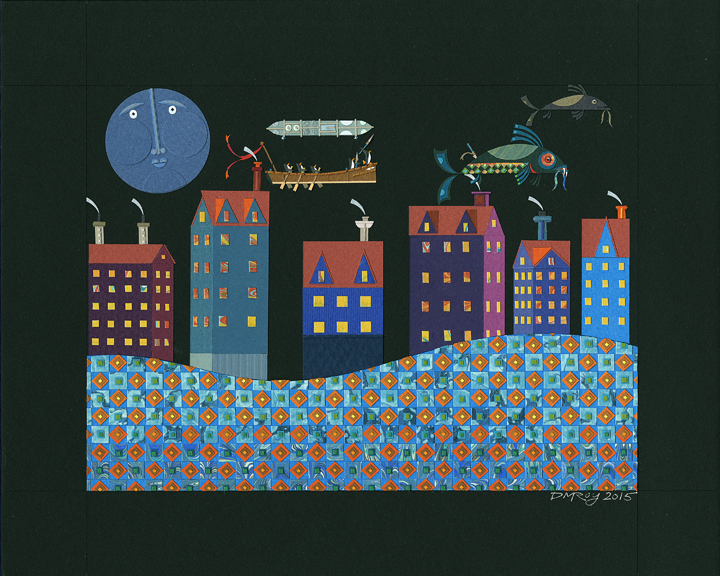
 Doug Roy, Fish in Sky, Cut Paper
The Greenhouse on Dupont
I’m back in that little apartment in Toronto,
ground floor, easy access
to the small play-set in the yard,
tiny kitchen, living room, bathroom, bedroom
in the 1970’s Italian/Portuguese section
near Dufferin and Bloor
with the formidable landlady, who seems so old
to my wayward teenage single motherhood,
a mother herself,
with young children.
Amid the brightly painted bricks, the grape arbors,
vegetables growing in every usable space,
I push your stroller up and down the streets,
drops of water on olive oil,
rumbling recalcitrant past
the disheveled roll-call of
crowded houses,
windows blinking, watching,
the bricks painted red, green, yellow, white
we trundle, two souls, one lost,
one cherished, past the churches
with their grand impositions,
drops of oil on holy water,
to the humble common ground
of Bloor Street, Dufferin Mall,
Christie Pitts, the tiny patch of public green
where the ladybug bit you
while we both watched. Forgive me,
I didn’t know that ladybugs could bite.
Then there’s the greenhouse on Dupont
with the old guy smiling,
“Come on in,” he says,
“pretend you’re in abbreviated Florida”.
I ease into the fragrance.
My windows soon fill
with tiny hopes
that I can afford.
____________
Carol Casey
Review by Rick Adang
All of the wonderful details here remind me of Richard Hugo’s advice in Triggering Town to anchor poems in real places. They take me inside this poem, let me feel comfortable so that I’m ready for the surprises, e. g. “two souls, one lost, / one cherished” and the greenhouse that is a transplanted patch of Florida in Toronto. Also the groundedness of the poem serves as a launching pad for the contrast of the lovely, airy ending: “My windows soon fill / with tiny hopes / that I can afford.” I like the push and pull of that ending: they are tiny and affordable, but still hopes.
Review by Zeke Sanchez
I like the everyday veneer of this poem. The poem is settled, a mother, in the far future, reminiscing about a walk with her baby (in a stroller?). She recalls the street names, the harsh landlady,the certain buildings, the feel of the place. Recalls the place was Italian/Portuguese Everything was small and probably cozy, despite the hardship.
The poet has a sharp eye for the details of her neighborhood, the one brought back in memory.
Review by Ben Sloan
For me part of the beauty of “The Greenhouse on Dupont” is the way that a carefully described stroll around the neighborhood, with an emphasis on vivid concrete detail, seems on the surface simple and straightforward–but at the same time points to depths of feeling and experience. For example, after a description of a “little apartment in Toronto,” the adjacent yard, the “1970’s Italian/Portuguese” style of the neighborhood, the eighth line in the first stanza, “my wayward teenage single motherhood,” tossed off as an aside in a long opening sentence, reveals so much.