
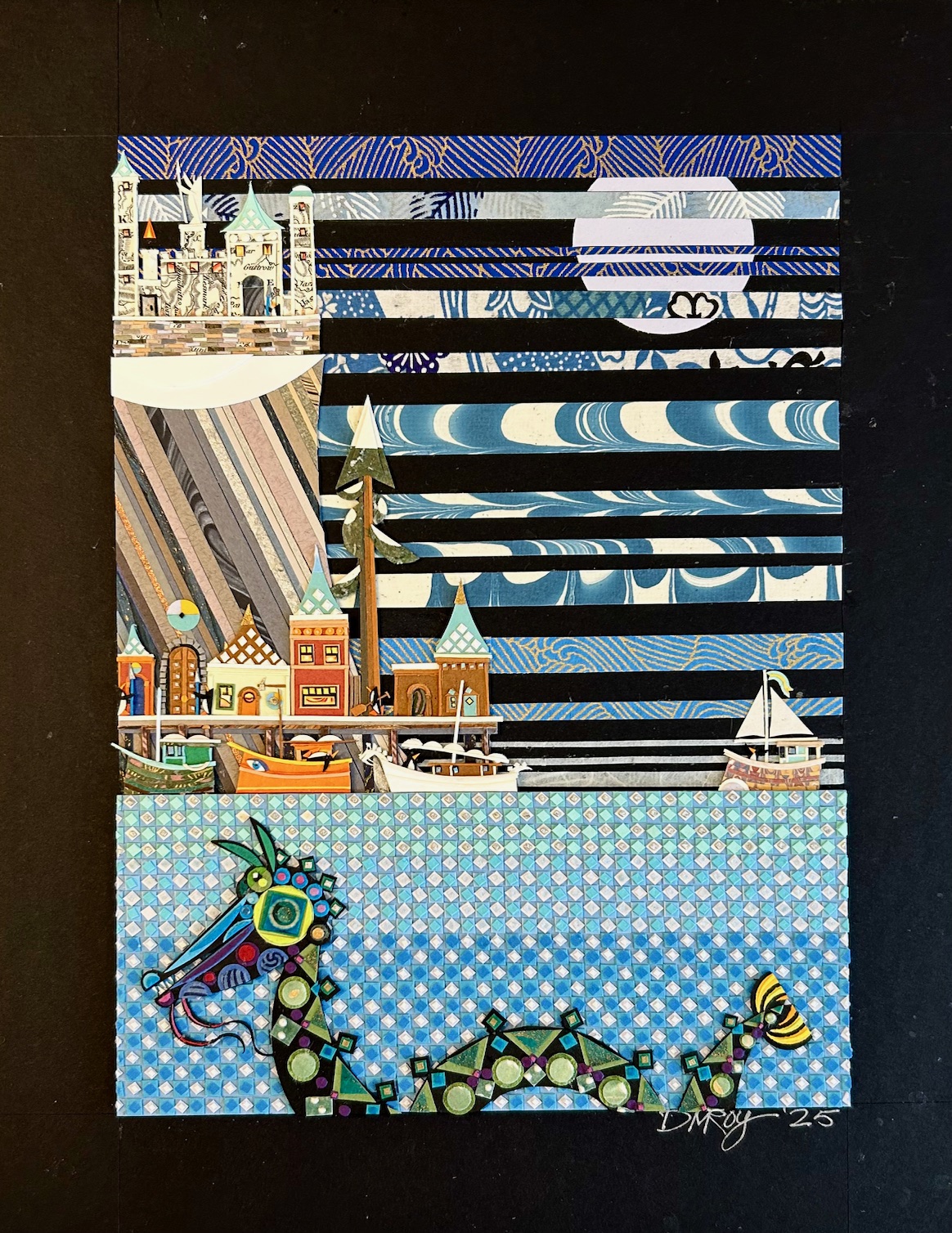
 Doug Roy, Serpent, Cut Paper
Night on Malibu Beach
Two teenage refugees from Joplin, Missouri
in an endless mist
cook forked clams over a can of Sterno.
I watch them sucking down
more sand than clam
charred and raw.
Her pudgy and pimply
him starved down to protruding bones
that creak as he chews.
One of us will die tonight
hero in a cliffhanger.
Drip-drip of hip conversation
and barbed wire silence.
____________
Rick Adang
Review by Dave Mehler
I think the brevity, and the quality or closeness of the observations here is what makes the poem for me. We learn a lot with very few words, and it’s all fresh and interesting. One question I had was the insertion of the “I” in line four–is the speaker a third wheel, or the skinny one whose jaw bones creak when he eats? Hearing the creaking might be an indication of the latter–something the chewer feels or hears? I think I might have omitted the ‘I’ from the poem, or at least considered it, in order to begin the line with “Watch them…” Maybe Adang made the best call. Tension is heightened by the supposition that one of them would die tonight, because it can go one of two ways, hyperbole and melodrama to match the ‘hero in cliffhanger,’ or the speaker is recounting past events without choosing to elaborate what might be the most important part of this story. The short lines, clipped images and alliteration throughout add a crispness and sharpness to this little vignette about country kids taking an adventure out west. It’s impressive if they found any clams under the sand in Malibu. I feel like the speaker is gently making sport of these (two or three), but as we might view our younger selves, without contempt.
Review by Ben Sloan
There is an appealing, at the same time unsettling (appealingly unsettling?) dream-like or dreamscape quality to all three of these poems that alternates between the ordinary, familiar, something one can almost reach out and touch–and the distantly horrifying. It is the mix of the two, or maybe the edge where the two meet, that is an exciting, if scary, ultimately appealing place to find oneself as a reader.
These poems remind me of the most recent novel by Thomas Pynchon, Shadow Ticket, where he, like Richard Adang, mixes the immediate and concrete, the familiar, and the frightening. We seem to be on a precipice, witnessing in ourselves or in the world around us an unsettling revelation. All these elements, for me, are embodied in the lines “Drip-drip of hip conversation / and barbed wire silence.” We like to think our clever conversations with our “hip” friends allows us some sort of refuge from the silence of not being able to understand the frightening unknowable world within and around us that we encounter during moments of aloneness and silence.
I love Flannery O’Connor’s novel Wise Blood that, like these poems, evokes the qualities I have mentioned above. I am currently reading Dostoevsky’s Crime and Punishment that does as well.