
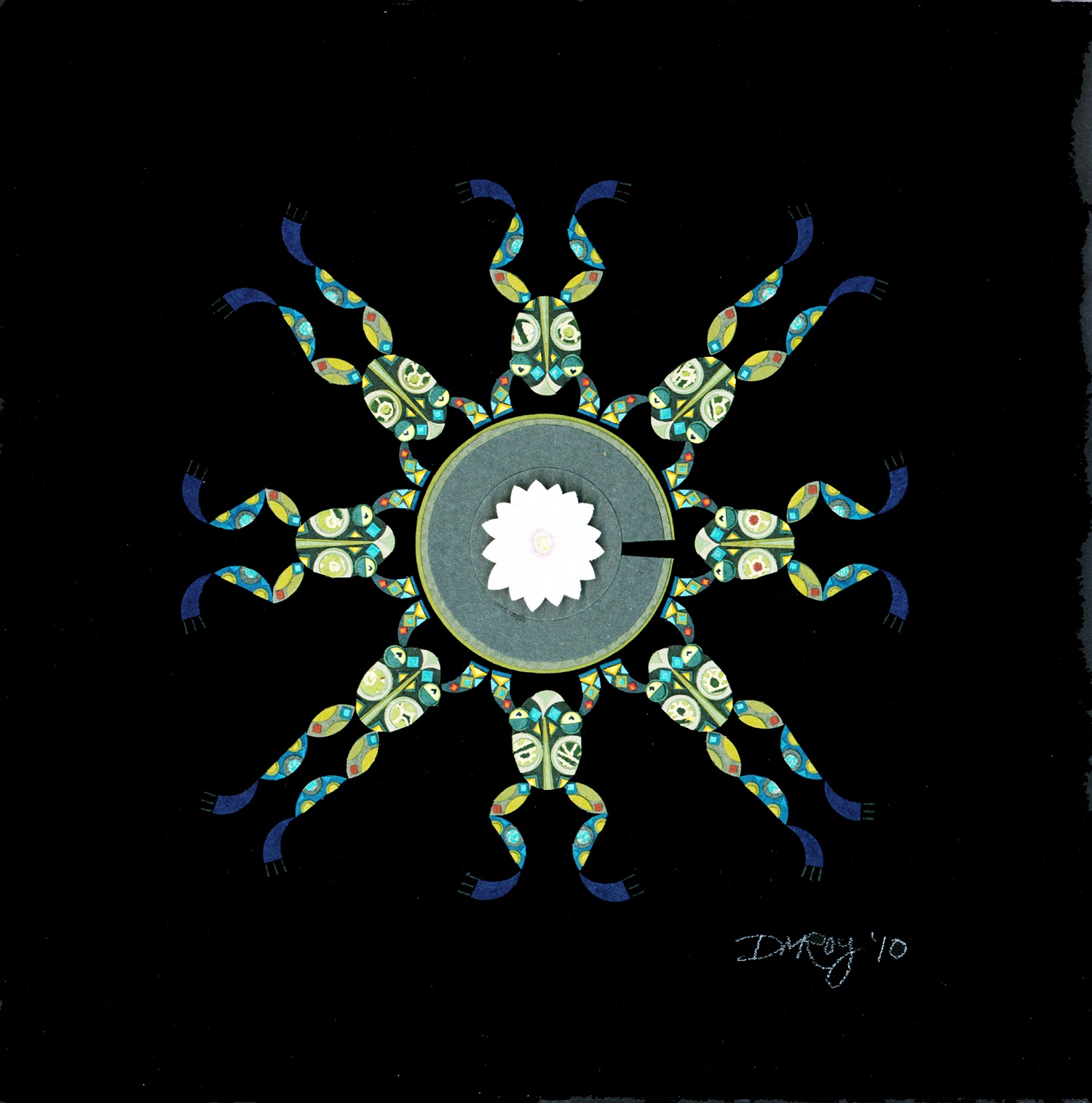
 Doug Roy, Lily Pad Small, Cut Paper

Iambe
No joke, she’s never worn the same outfit twice.
Today, her shirt’s a canny hand-stitched reproduction
vintage-90s soft-weave cotton-construction
fuchsia Tastee-Tee—glitter-flaked device
a rainbow over rampant horse, with shooting stars
—one size too small. Taupe miniskirt, pilling tights
the brokest pair of Docs debased to just the right
aporia of Hubba-Bubba gum-smeared tar
“Transgressive!” rave the Tick-Tockerati. She prefers
“freak.” Her installation of Clément’s “tarantella”
as witchcore suite went double-viral. Her sisters
confide the cutting—then, later, her paper-doll
amputees, Groomsman’s Prostheses for Falada
those Medusa heads painted in cereal bowls.
________________
Manny Blacksher
Review by Rick Adang
A nice thing about poetry is that, besides the pleasure of the verses, I often get to add to my meager store of general knowledge. The title of this poem sent me to Wikipedia, where I discovered that Iambe, in Greek mythology, was the daughter of Pan and Echo, and the granddaughter of Hermes. Her name means “banter” in Greek and she was thought of as a prankster. Great! So Mr. Blacksher seems to want you to know all that, starting the poem with “No joke.” Lots of bantering in this rambling joy of a poem. Updated version of the mythological girl or a living, breathing woman? Matters not, since Blacksher has brought the character to life. A true picture of a prankster. The energy of this poem is wonderful. My favorite line: “aporia of Hubba-Bubba gum-smeared tar.” Yes, I went back to Wikipedia again. Aporia means “a logical impasse or contradiction”. I love the mixing of this lovely Greek-derived word with the pop culture Hubba-Bubba. Besides, rhythmically that line is so jagged and appealing.
Review by Ben Sloan
Of these three sonnets–one celebrating the Thracian jester-like Iambe working to cheer up the mourning Demeter; one evoking the Grand Canal and other waterways in Dublin; and the third, honoring darkness and what we see when we cannot see anything–my favorite, maybe (though I love them all) is Dublin 12.
The highly compacted, scrunched up one part next to others, imagery suggests fast movement, traveling at hyperspeed through thoughts and feelings. The line(s) “Rocks / in our pockets” makes me think of Virginia Woolf’s suicide, all the water suggesting To the Lighthouse, a favorite novel of mine, maybe my all-time favorite.
These poems have a collage-like character that is dizzying, kaleidoscopic, and delightful. This texture of the writing inspires rereading in order ( for my part) to discern the edges of the world being presented. “How to Previsualize Your Pictures,” among other things, seems to me a meditation, in part, on the author’s style, how the blender-like mixing of parts at first makes it hard to focus, giving one the feel of fumbling around in the darkness of this new unfamiliar room one has entered–but, upon closer inspection and familiarity with this new at first unfamiliar world, the light shines through.