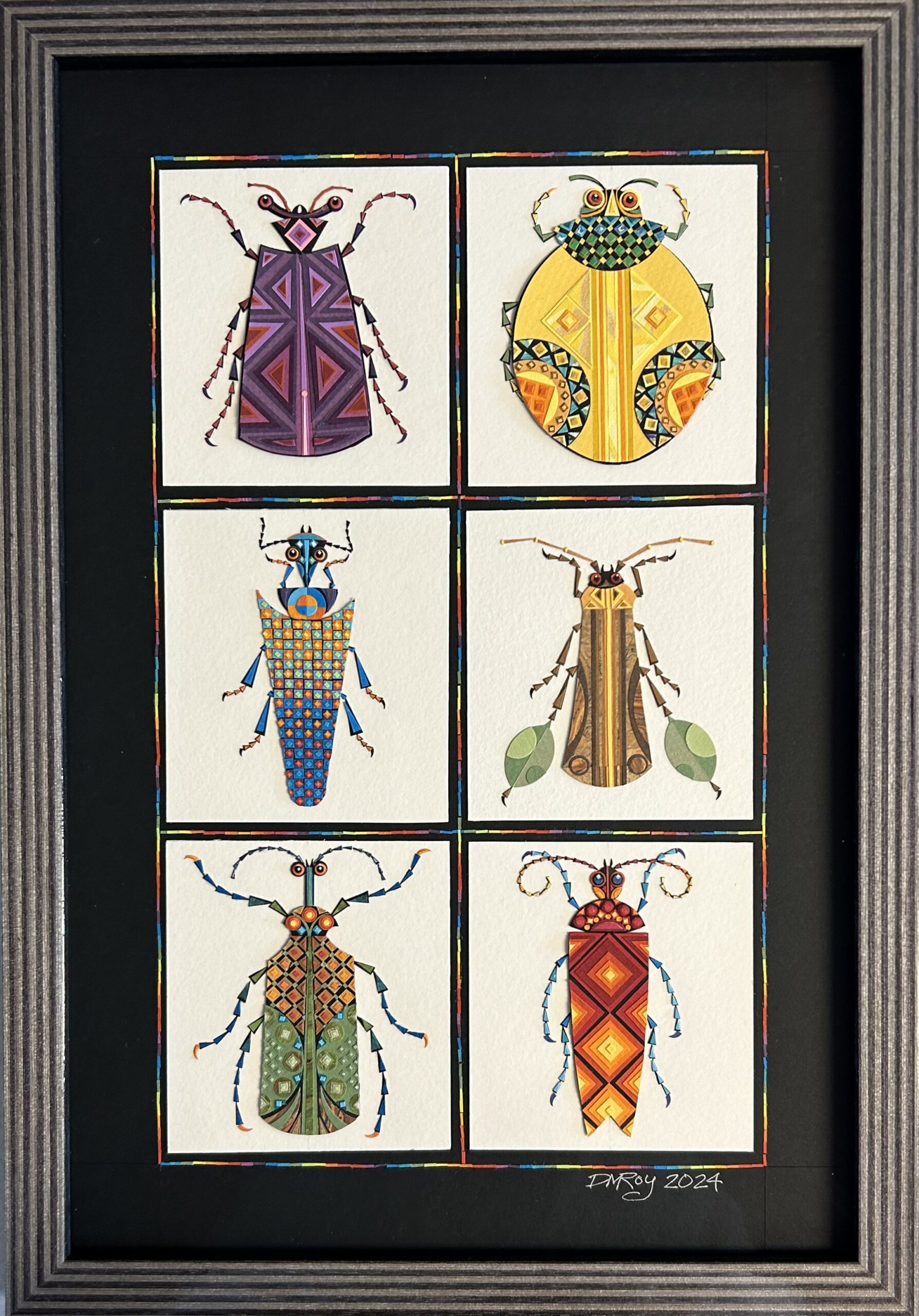
 Doug Roy, The Collection, Cut Paper
Subtraction (Velia, Summer 2022)
Levi-Civita found all the theorems / on the liquids’ equilibrium / […]
No attrition between two drops / of water.
Leonardo Sinisgalli, “L’equilibrio”. Dimenticatoio. Mondadori, 1978.
My translation
Sifr, the Arabian wonder, the no thing that is and does. Zero.
On this bed, this Saturday afternoon, one can distinctly hear
The surf of the sea, the boats, the tower, the shore sing as one:
Everything is finite, the limit sets the value, none is beyond.
So, in this historic strait of war, hunger, drought,
What does it mean or matter all the love I knew, I felt,
Whatever its cipher, order, has been reduced to non-being?
Zero. Mirror without us.
From the Rose Gate parting night and light1, around the hill up to the tower,
Chariots of twin horses keep racing, pain and waiting for it2a against bliss and its memory.
Prize is learning the just limit to oneself, knowing the limit makes oneself,
That finite is the curve of the brain, scars, the tube of the waves,
How these drops of nothing were already there, then, particle of us,
Like water without attrition, learning the theorem on equilibrium.3
Has everything paid its due today, so that2a,
However tomorrow may be, it could walk free, or not be?
Imperceptibly, the many, usual thoughts and I are being undone;
Only this summer wind still circulates in these rooms,
Everything hit and drawn away, according to its rule.2ab
Would my nothing be complete, finite, be with yours at one,2b
As the rest of me are these specks of dust on the reflection of you.
Notes
- Parmenides, On Nature.
- Sophocles, A: Women of Trachis; B: Electra, versi vari.
- “Levi-Civita trovò tutti i teoremi / sull’equilibrio dei liquidi / […] non c’è attrito tra due gocce / d’acqua.”
______________________
Massimiliano Nastri
Review by Bruce Parker
I need to return to the poems of Massimiliano Nastri, they are complex and require deep attention.
Review by Dave Mehler
As Bruce says above, the poems of Massimiliano Nastri […] are complex and require deep attention. Indeed.
While I think this poem is difficult, there are some things that can be said, or at least pointed out. Velia is a woman’s name, and is also a word with translates to mean, veiled, hidden or concealed. It is also a city on the southwestern coast of Italy right at the top of the boot, which also has an ancient Greek history. I believe since the title names it along with a date and the poem references the sound of surf, this is the primary meaning, and was most likely a site of vacation or pilgrimage for Mr Nastri? Visiting Velia inspires a poet’s reflection on the mathematical figure of zero. Zero or the Arabic, sifr, allows Nastri to extend this figure metaphorically as a stand in for ephemerality, finitude, nonexistence, nothingness, or existence for all too brief a time raising the question of this central mystery/’cipher:’ Why, to what purpose? The poem includes a lot of play, some erudition with footnotes, which I think is additional play but also a more serious sign of resignation. No matter how smart we are, how clever with words or ideas, how vast our erudition–we can’t ever seem to solve the problem of brevity, eminent death, and transience not only personally but also the eventual extinguishment of all that glory in history, intellect–Western Civilization coming to nought before, during or after our brief span of 80 or so years? If not extinction, at least change or deterioration. One playful aside is the suggestion of interplay between zero as mirror, us as drops of water or containing water being beings of water, but also dust, and ‘reflection’ as thought or image in a mirror–a zero shaped mirror, drop of water? I wonder about the ‘you’ in the final two lines…who is being addressed? The speaker talking to himself, or a lover, a friend? God? There seem to be endless avenues and interrelated things to ponder in this poem, which reward repeated rereadings, as Bruce also notes above.
A recurring theme in all three of these poems in the issue is not only physical, literal geographical locations, places of home (?), but also light, and the concern for humanity’s existence and the many perceived threats moving against it.
In his first poem of this issue, “Thebes, First Day of Summer, ” he closes with these lines:
How tomorrow morning will be just another half treason of all those we commit,
For all to see and ignore, panorama of all the things that want to be, and fail,
You as well, and the light all over it.
In the second poem, “Must we have a future?,” we find these lines, which echo the third poem, above:
This miracle of nothingness, learn from the indifference of light
And the empty spaces around it, to mean something between them,
And let it go, collect the darkness we have been paying for all this time,
The same preoccupations and questions are being posited throughout; all is not right with the world, but despite this perhaps we can still aspire to some joy, play, deep thought, poetry, and if we don’t ultimately have a future, well, so be it–what can be done? I enjoy his whistling in the dark, but would respond to Massimiliano with this, Is light indifferent? Despite scientists arguing whether light is particle or wave, and more recently a field, some have speculated that whatever light is, it retains a record within itself of everything since the beginning of time and the universe! If this may be so, even aside from any metaphysical speculations for those of us who dare to entertain them, would it still be accurate to say light is indifferent?? Stylistically, I enjoy the long, meaty lines, and paragraph like stanzas, also the intertextual references and clues–it’s a rich feast, these poems. Feats of substance, inquiry, thoughtfulness and play. Weighty but bouyant rather than cumbersome, personal rather than abstract.