
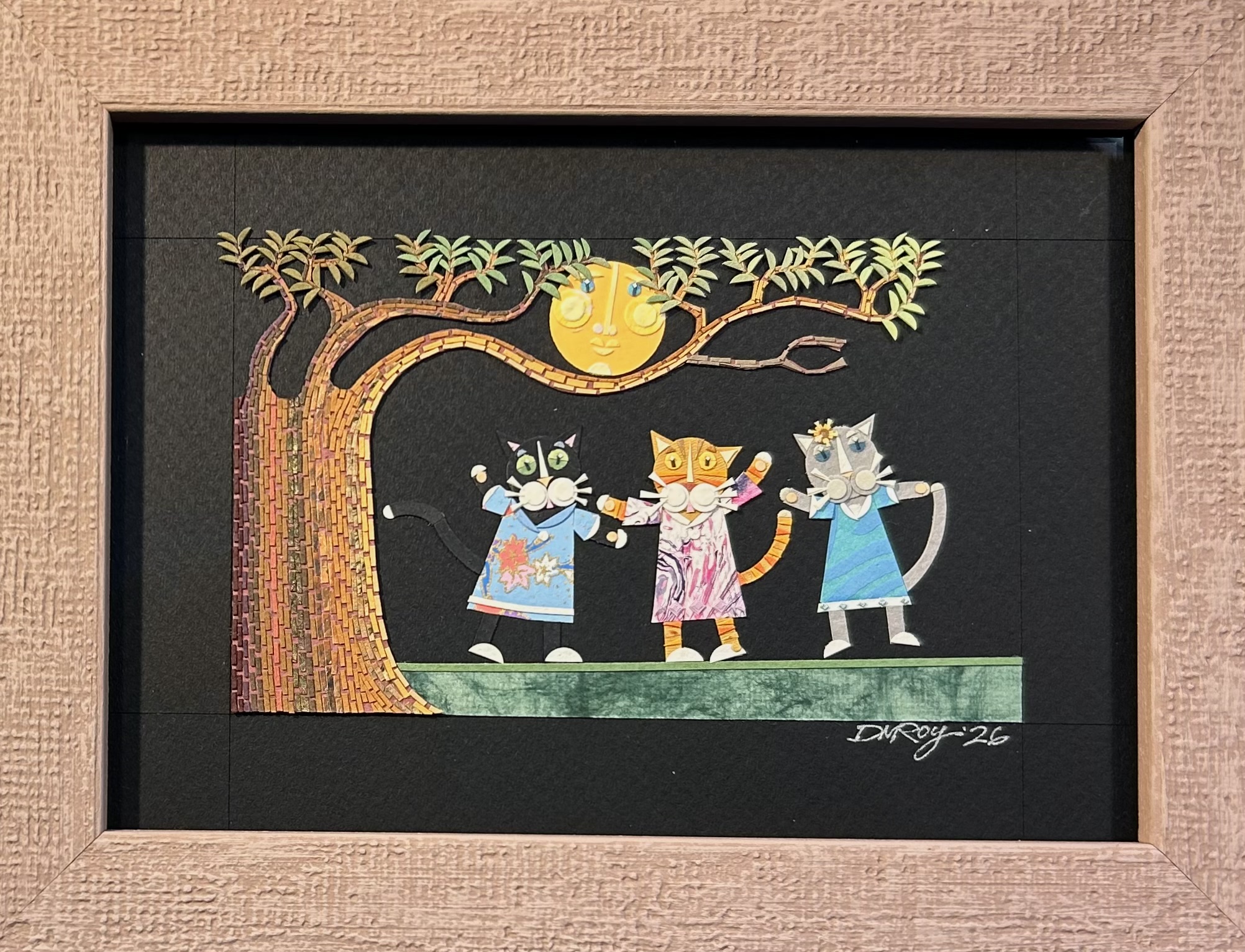
 Doug Roy, Cousins, Cut Paper
the earth is approximately spherical
not precisely round, closer to an ellipsoid –
a blimp or egg, loaf of French bread
she is oblate, astronomers explain
a solid compressed, a Rubens nude
lounging in an unmade bed of sky
flaunting latitudinal stretchmarks
terrestrial pockmarks, an equatorial
pudge, the inexplicable allure of planetary
imperfection – crooked smile, chipped tooth
waning moons, Picasso blues, worlds artfully
askew, like cracks in the glaze of a ceramic
vase holding fading blooms
falling petals
all the earthly flaws
of beauty familiar
____________
Lucinda Trew
Review by Massimiliano Nastri
The ease she had in moving from technical description, the images accumulating, climbing on top of one another (a Rubens nude has forever altered my late night with a telescope here in Belfast, when it is not cloudy), the tone serene without pretence, everything does lead to the morality at the end, something I agree with, even before my age (fading blooms, cracks in the glaze, earthly flaws). Sound, sound was enveloping, which – I guess – was the point of the continuous and continuously imperfect metaphor of imperfection: not precisely round, a blimp orégg, loaf offrench, òblate, astronomersex/plain, flaUnting latitudinal.
Review by Philip Kirsch
I love anything that reminds me (us) of the imperfections and uncertainties that surround us, that make our universe unique and keep us alert to detail and change. And this poem definitely does that. You see, that famous picture taken from space of our perfect, round earth — well, our earth is not “precisely round”; it is even, only, “approximately” spherical, more like “a blimp or egg” — the comparisons are deft and in good humor.
Reading beyond the first stanza, the next two humanize this “solid
compressed” that we humans live on, this “Rubens nude” “flaunting [love that!] latitudinal stretchmarks,” “an equatorial pudge” and “crooked smile,” among other charming attributes; indeed, comprising “the…allure of planetary imperfection.”
To me, the final stanza is a closer look at the borders of land and sea, “like cracks in the glaze of a ceramic vase,” or, perhaps, the lines we see on an aged face close up? Because this world is aging, likely faster due to our actions, as implied by the “fading blooms/falling petals” — those “earthly flaws of beauty familiar.”
An original insight expressed very well!
Review by Marc Janssen
The poem title is a statement of fact, then as the poem moves on it becomes more and more metaphorical. To me one of the most interesting aspects is the final three lines that unhook from the left margin and float away kind of a like a metaphor for the poem itself.
Review by Jared Pearce
Really fine imagery here, which I find very fun, very refreshing. And though the objects differ, theme-wise the poem recalls Herrick’s, “Delight in Disorder,” a correspondence that, for me, enhances both poems.