
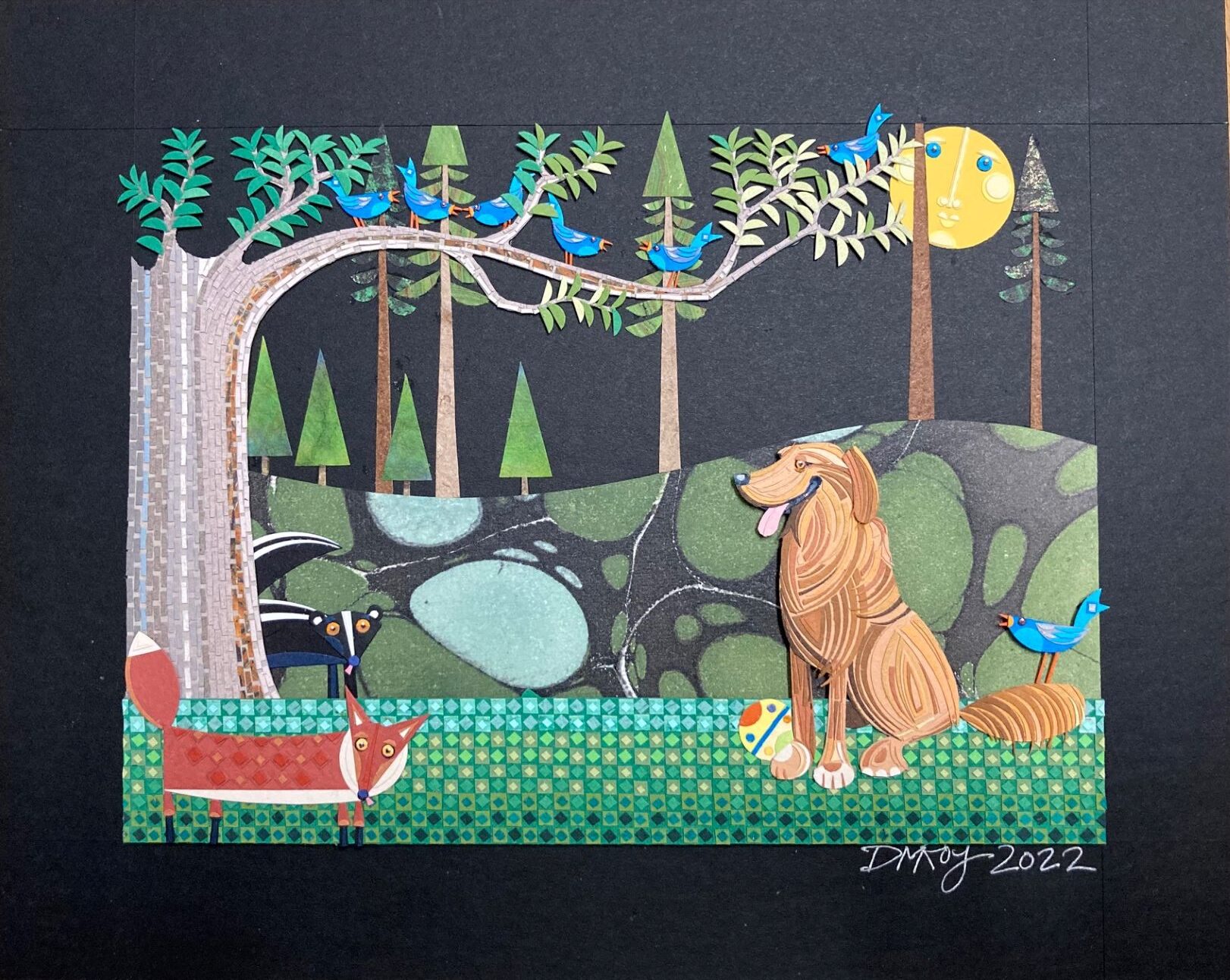
 Doug Roy, Play Ball, Cut Paper
Long Playing Record
Dear Mr. Lightfoot:
You were our Saturday Bard for many years growing up. Dad poured driveways until Saturday, then let the needle down on your LP. When dad moved out they split the house up, divided the dogs, each took their own books, she got the antiques and the collie, he got the tools, the mutt, the music. We were shared back and forth. You were one of the few constants, your face was staring out from the window of your record cover like a posted sentry looking after any place my dad was renting as he started over.
In his dinged up Airstream camper living below the hill from the black-haired Cherokee lady who ran the Indian store and the campground, your voice would echo in the wet woods where we slept every other weekend in cozy bunks, breakfasted early by the fire with bath towels folded on the camp chairs against the dew that bathed everything and pooled in the blue and white enameled tin-ware and made the dappled light sparkle across the understory on the edge of town.
Dad played you up into the gabled ceiling in our blue sided duplex by the cul de sac we’d orbit on bikes like a turntable behind the drugstore. We had just enough furniture – the oak dresser with the white porcelain knobs, the sideboard he’d found on the power line trail, the old wire milk crates he pulled out of the woods in the 60’s – with the wood slats and the folded riveted sheet metal corners – that made our tables and stools and were heavy holding the record collection.
Then we roomed in the state park, woods and marsh in every direction, with the Ranger and his southern drawl and belly laughs with his head thrown back and his gold tinged husky mix with the coiled tail that dad wanted to anchor with a brick to straighten out. We’d close the gate in the evenings at dusk locking ourselves in, making the whole place ours and the sky too and the woods came alive with night noise. In the meadow the stars were laid out like strewn stones.
It was about then I started to see something of wildness behind your words, when wildness was a long way off for a couple of brothers being taxied around. The way you stretched or warbled your lyrics. The way you hinted of places to be drawn to or warned off from, it made me wonder of dad’s own voyages to Greenland’s Dew Line, Pike’s Peak marathons, Saigon’s Long Binh Post.
Later there was the prefab house at the river that dad lost money on for being too nice. Its woodstove ticked all winter, crickets in the walls ticked all summer, sycamores dropped whole branches in the fall and the huge leaves would dry and cup into brittle scrolls and crush like empty cans under the wheels of the blue Jeep Cherokee I was learning to drive, and our sad mutt sat in the corner behind the fire screen and stared us down while you sang in the evenings and dad grilled chicken and invented his mean bean soup.
We didn’t exactly want your stories for our own. We were coveting other things – surfer tee shirts, being hairier and taller, muscles for fending off assholes punching us in the school hallway. We didn’t mind someone else telling of pain harder earned than ours. You had gone and sought it out and we knew you’d been down on your luck too and that made our hand of cards seem more bearable. You said things like bow your head and pay up, wisdom’s never free; some grudges are comforting and long in letting go; too drunk is too many, and too late; trust a slow-loving woman, and keep her close; there’s beauty in the ordinary; you can’t outrun homesick; trouble will find you so know where the door is; find your forest; listen to the rain; honor the dead; retell the hard tales.
Farther down the road I was some years and miles distant when I saw your face in Normal’s Record and Books in Baltimore. It was as if somewhere from outside of me someone had just lit a fire in the center of my chest. How long had you been looking for me? That day I brought you home to meet my new wife and all Summer and Fall you played just for us on our day off, when we traded church for sleep and fresh biscuits on our deck and the sound of city dirt bikes and the bright light off the reservoir coruscating on the crown glass windows, and you became our Sunday bard. And all that first winter the ice crept across the water and the fox would bat rats around like hockey pucks and the wind rattled and let itself into our Victorian house 2nd floor apartment with wide moldings, transom windows, the claw foot tub, and a stained glass window in the stairwell above the pair of old maids who wrote poems on the first floor and glowered at Cranston, the wry old school teacher next door who called them “his bitches” with a contagious grin I couldn’t resist answering. And by Spring we had a baby and a suspicion that life was too easy.
You gave melody to things we hadn’t faced yet. Pain and sorrow hung on your voice like ribboned wreaths. You made grief worth hearing about, even for newlyweds. Your words held us. Your preludes burst suddenly from the speakers like pigeons from rooftops exploding into flight – your guitar now weeping like a harp, now bearing down like a train. Your voice always could be a howling wind or rippling water. And there were 5 more houses for us between then and now, plagues of various kinds, times we never unpacked the records, times we didn’t know peace or rest and we were sustained by strangers, and times when we held hands tight and prayed, still didn’t know peace but had life and could walk to church where the old people, who’d lived a longer road like you, took interest in our children and that sated us.
Then a Summer came when we were 4 kids in and one had nearly beat the cancer, but was still taking the poison meds and she was expected to live, which meant we were all going to live, and I bought 2 tickets and found myself standing before you, Mr. Lightfoot, under a canvas pavilion roof at a concert downtown at the harbor’s edge. She was half my size then, with new hair down to her unpierced ear lobes and a white dress embroidered with white flowers and a straw fedora with a blue ribbon around it. I had no beard then. I’d shaved it to feel her bald head on my face the year before. And we stood on the hill of the amphitheater with the water at our backs and stomped and twirled and danced and clapped and you played all your songs from a chest with pneumonia and they were only two verses long, but they were all there, the whole gold album and more. In the midst of it all I could not separate your voice and myself from my father or my brother and the miles we’d covered and years of that cramped, clumsy love that didn’t come easily to us boys and with my back to the stage and my face to the harbor I let a little girl dance around me and let tears fall. When the sun went down and you’d sung yourself out we stood around and got real close to you and the limo. And you said to a small crowd sorry you couldn’t stay, and that you needed rest.
You were smaller than I imagined, and road worn, frail from 2000 shows behind you. But I could see it was you from the album cover, recognized those eyes that had looked straight into the camera. Eyes that had stared out at us for so long. You were enormous to me, with hair like a thick mane. Yours was the biggest portrait we had, your face on the cover edge to edge standing on the shelves of all those houses felt to us like a relative always checking in. Later I learned your voice had crossed Canada and the lower 49. You were something of Renault’s old king, having racked up thousands of miles seeing all the royal courts and arenas, met all the women, heard all the stories, ate at all the tables – choosing from dreams and petitions the ones we needed to hear. You weren’t punchy like Dylan, didn’t have John Prine’s sarcasm or John hiatt’s ease, or Tom waits shadow. You were closer to the cowboy guy Michael Martin Murphy. These were my benchmarks. You sang with melodies that made the words linger. Your voice caused us to listen even when we couldn’t listen to each other. No matter how close we sat, our father couldn’t say all he wanted to. Perhaps none can. But in the tales you spun were lessons worth knowing. Sometimes you stood in for our grandad and told stories without the N word. Other times yours were stories my uncles might’ve told if only they’d have rolled out on the mechanic creepers long enough to know their nephews. Dad gave you permission to sing to us. You and he both had Gibson 12 string guitars after all. For that we took you seriously. Over time, the bright ring of a 12 string staunches something that’s bleeding out of a father and his young sons.
Thank you, from the young dad with his little girl at the limo after the show.
_____________
Jessie Reid