
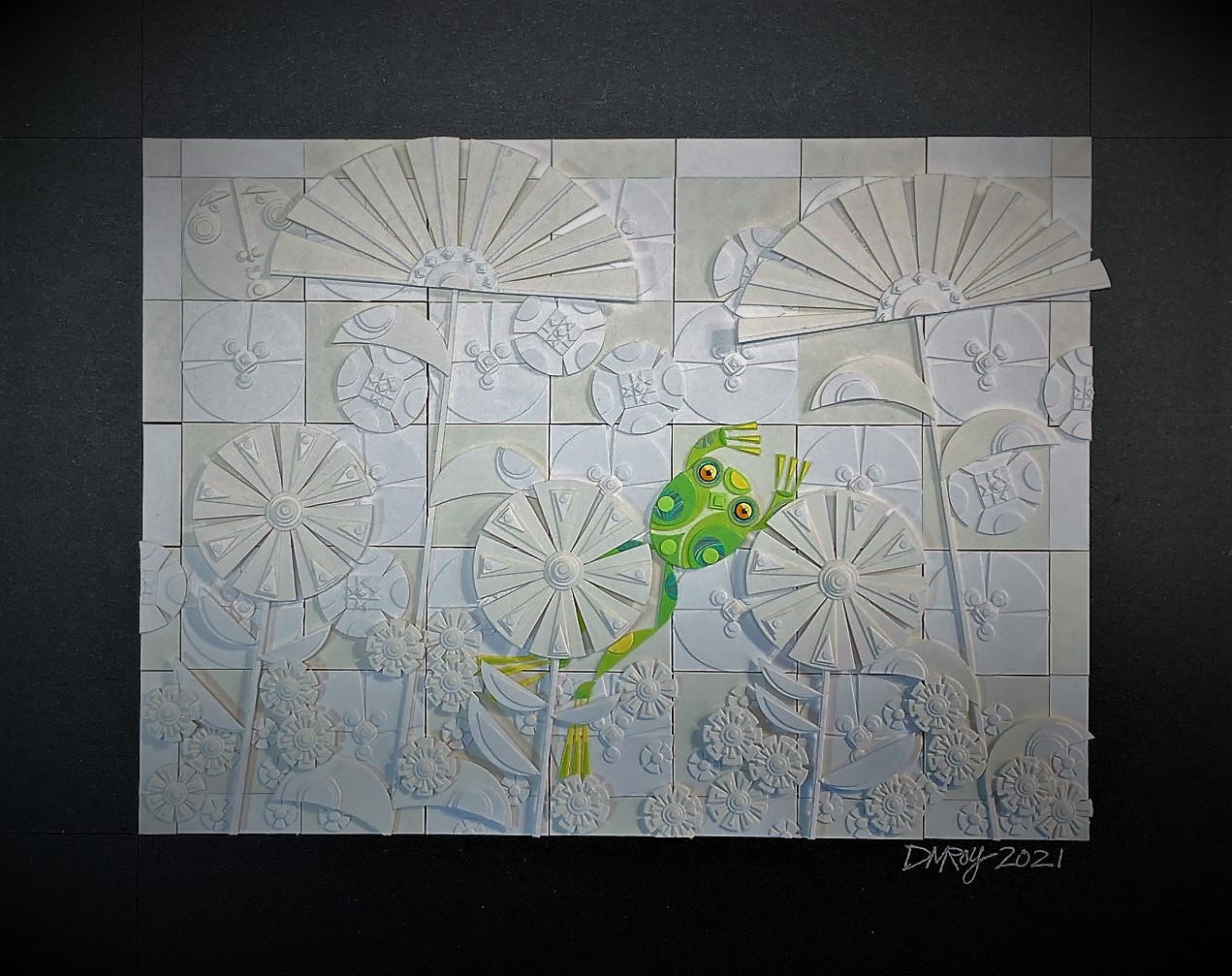
 Doug Roy, Oregon Tree Frog, Cut Paper
Letter from the Editor
This issue is dedicated to Paul Nelson, poet, teacher, and friend. He passed away February 27th, 2026.
On January 25th Paul wrote to me:
Dave, need a little help.
Age 91, I am in re-hab
Headed for hospice.
No cut and paste, tricking these 3 poems
To you by heisting from
Email by x-students, now dear old friends.
I want you to see these,
Knowing you don’t do
b.s . Steven’s wrote, “Sentimentality is a failure of feeling”….
Be well, Paul
The poems were, “Death,” “Moaning and Wheezing,” (which you can read in this issue) and “Far Bank.” I was planning to publish the other two as well, but Jane Ann Fuller, a previous contributor and a mutual friend of Paul’s who’d written with news of his passing, also let me know they’d previously been published. This was Paul’s way of saying goodbye to me. Too hard to find and copy and paste, but able to find and forward them to me from a previous email! It suggests to me that he thought both I, and the poems, were important enough to get them to me. Also an anything but maudlin way to let me know he was dying.
I can’t help but be struck by this. Here I am asking myself whether poetry matters, and if so how much. I’ve begun saying to friends, “Poetry is the most important thing and the least important thing in the world.” But lately wondering about either claim in that sentence.
On June 6th, 12:51 my time, Dmitry Blizniuk says, “Over the last few days, we’ve been heavily shelled with Shahed drones, but from midday today until right now, it’s been relatively quiet, so we can breathe a sigh of relief.” In a previous letter, having gotten through an especially freezing and heavily bombarded winter, he told me, “I hug and send a photo — this is mom with tomato seedlings, I set up a high shelf today, and put the small one away in the garage, right behind this window Shaheds fly and explosions, and her tomatoes are symbols of her unbreakability. My symbols of unbreakability are poems.” Here is the photo:
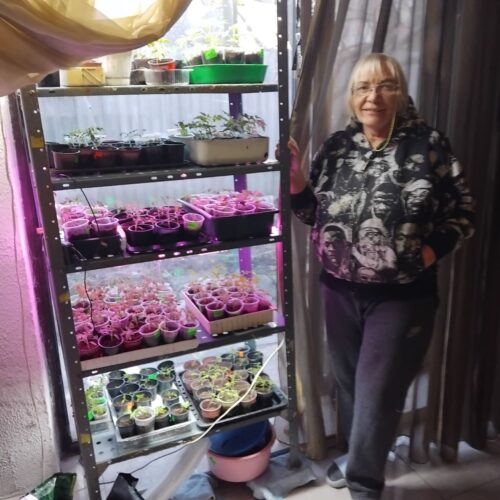 04/13/26
Tomato seedlings and poetry as symbols of unbreakability.
In the introduction to the book, Diaries of Exile, we learn that Yannis Ritsos, imprisoned at Makronisos as a political dissident in the late ’40s was writing poems on scraps of cigarette liner papers and burying them in jars around the yard. He couldn’t guarantee that the poems he wrote on postcards to mail to his daughter would make it out uncensored. The phrase ‘WRITE ONLY 10 LINES’ in his November 8th entry of Diary of Exile I, for instance, is a direct quotation of the instruction censors stamped on prisoners’ outgoing, government-issued postcards. —from the Introduction by Karen Emmerich, one of the translators (along with Edmund Keeley).
Here is an excerpt:
June 1 1950
In the morning
the horizon is
the whitewashed facade of an orphanage.
In the evenings it hangs
from the cripple’s crutches
like an island sock full of holes.
At night those killed
gather together under the stones
with some notes in their cigarette packs
with some densely scribbled scraps of paper in their shoes
with some illicit stars in their eyes.
Above them the sky grows larger
grows larger and deeper
never tires
I can’t resist offering another:
May 15, 1950
The guard sits behind the barbed wire
the lapels of his trench coat raised.
The other day I noticed his arms
they are thick and strong
he would have carried the flag in one of our parades.
Now he sits behind his rifle
as if behind a wall.
Behind the wall sits spring–
he can’t see it.
I see it and smile
and I’m sad
that he can’t see it.
He’s bound in the shadow of his rifle around my eyes
as if it were a black handkerchief,
but I want him to see spring and smile.
Ritsos writing poems on shreds of paper and hiding the poems in jars in the ground (how on earth were they ever recovered!!), and Dmitry Blizniuk’s symbols of ‘unbreakability,’ both remind me of Miklós Radnóti. From the biography of Clouded Sky, at the back of the book are these details about the end of his life: Beginning in 1940 he was sent to a number of forced labor camps. At one point he worked along the Ukrainian front, arming and disarming explosives; finally in 1944 he was taken to Bor, southeast of the Hungarian border. From there, the Fascists drove him and the rest of the prisoners across Hungary to the town of Abda, in the northwest of the country, where, no longer useful, the workers were beaten to death and thrown into a mass grave. Surviving prisoners had smuggled copies of his poems out of the camp, but the five written in his last days, ‘Roots’ and Postcards 1 through 4, were unknown until his wife discovered them in his grave.
Postcard
1
From Bulgaria the huge wild pulse of artillery.
It beats on the mountain ridge, then hesitates and falls.
Men, animals, wagons and thoughts. They are swelling.
The road whinnies and rears up. The sky gallops.
You are permanent within me in this chaos.
Somewhere deep in my mind you shine forever, without
moving, silent, like the angel awed by death,
or like the insect burying itself
in the rotted heart of the tree.
In the mountains.
Postcard
4
I fell next to him. His body rolled over.
It was tight as a violin string before it snaps.
Shot in the back of the head–“This is how
you’ll end.” “Just lie quietly,” I said to myself.
Patience flowers into death now.
“Der springt noch auf,” [They rise up] I heard above me.
Dark filthy blood was drying on my ear.
Szentkirályszabadja
October 31st, 1944
–from Clouded Sky, translated by Steven Polger, Stephen Berg, and S.J. Marks.
Tomato seedlings and poetry as symbols of unbreakability. Or symbols of spirit in the face of death, exile, or imprisonment, during a time of seemingly unending war and artillery shelling of civilians. Poetry is the most important thing in the world, or the least important, or both simultaneously?
Poetry brings us a necessary news of the world.
Welcome to Issue #36. Not all the poems included here are this dramatic or come from such lives in crisis. But there are proper times and places for all poetry, and there’s plenty of variety in voices, preoccupations and takes on the world. I hope you enjoy what we have for you this time out.
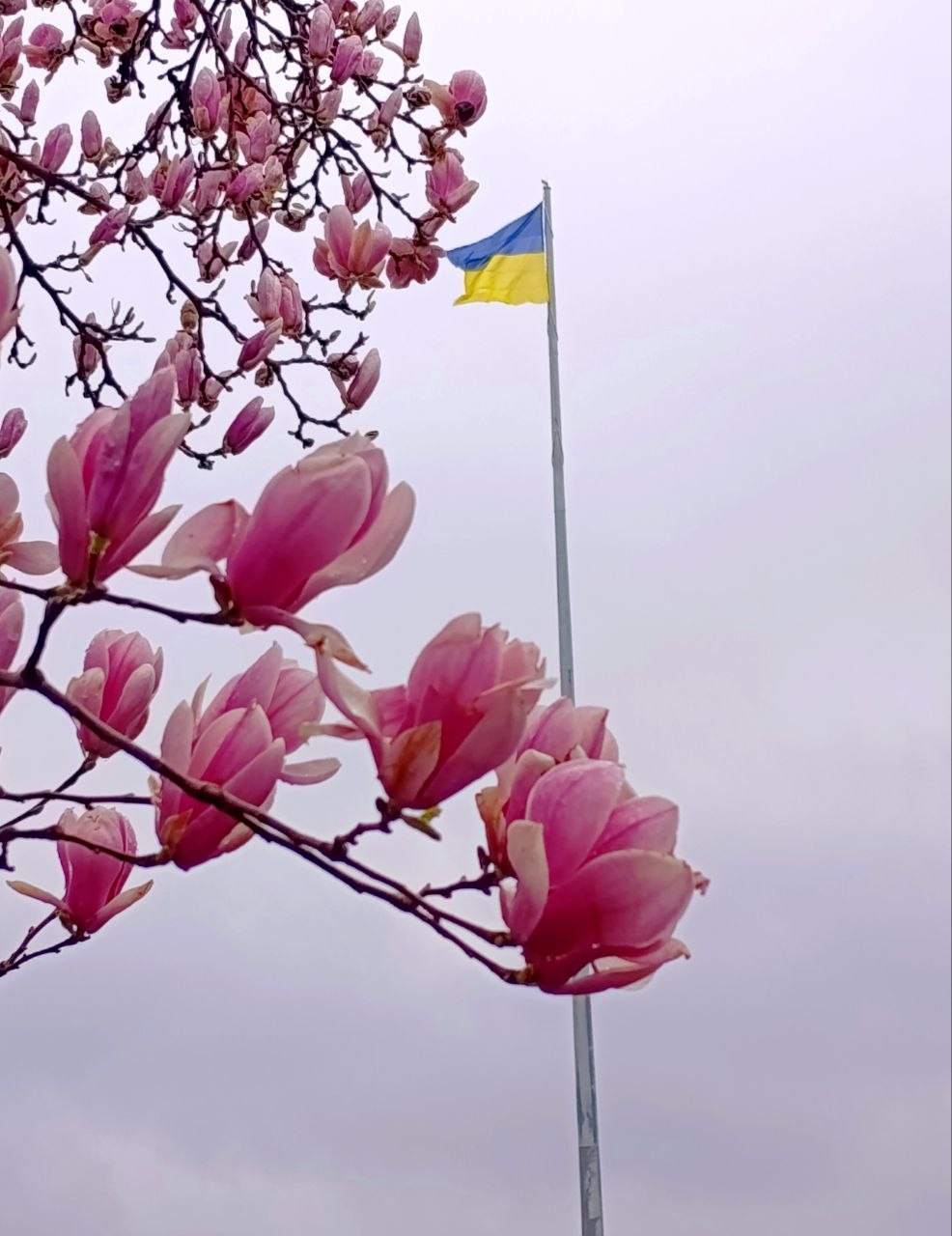 Photograph by Elena Semeryak