
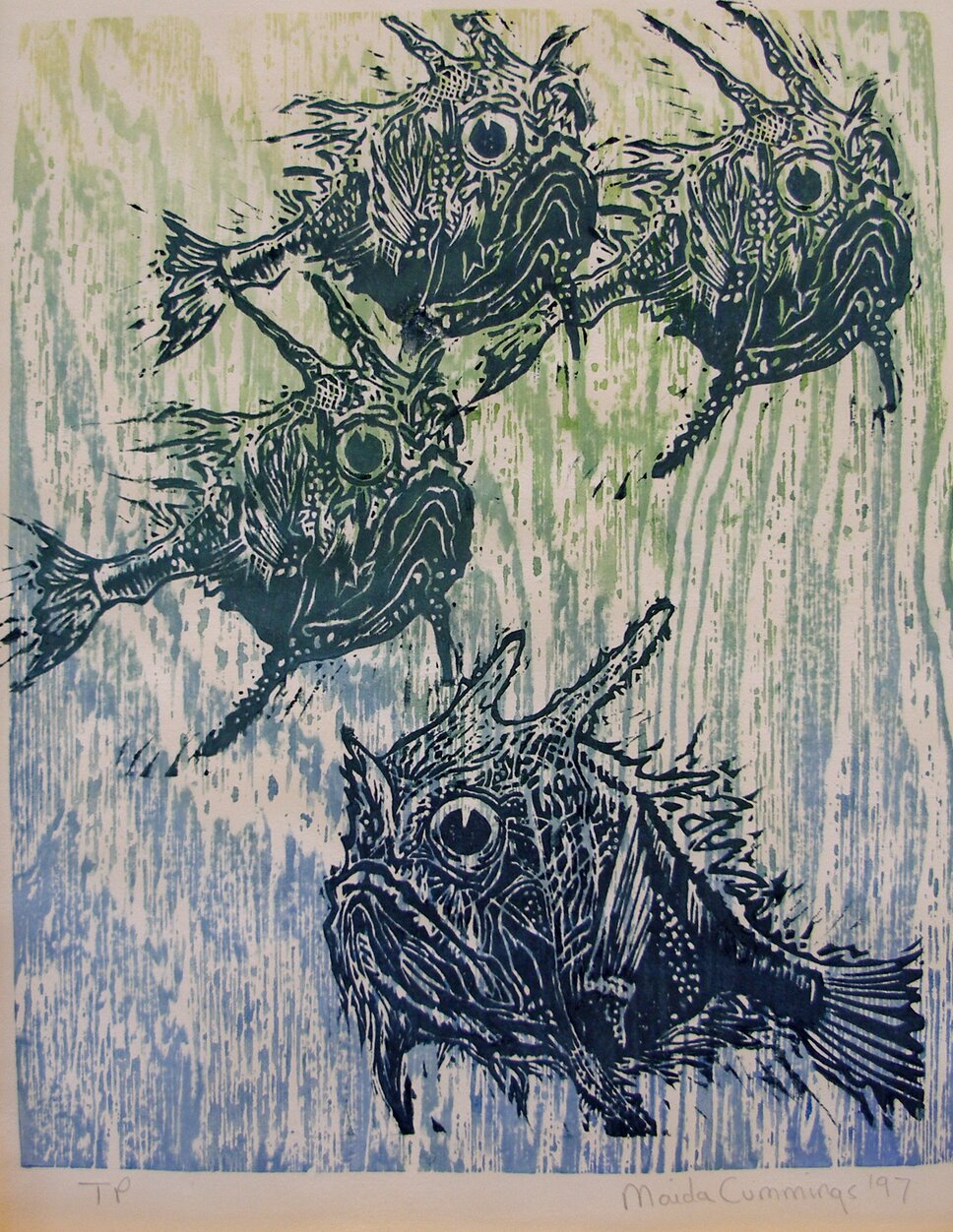
Fishbowl Father
I don’t really know him
He doesn’t understand me
Two fish in a bowl
Circling
Seeing each other for the first time
Every ten seconds
_____________
Rachel Turney
Review by Douglas Cole
What I love about Rachel Turney’s “Fish Bowl Father,” is its clean, stark imagery: these two fish, trapped essentially in their bowl of life. And like a lot of family, we are often close but unaware of each other, really. We can be in the tightest of quarters and still not know each other, not see each other. And the way Turney presents the relationship of the poet and the father places no blame. It’s not a judgment poem. It’s an observation poem. The ‘tragedy,’ if there is one, is a being phenomenon: child longing for parent, parent mysteriously unavailable, child unable to break through, both parent and child unable to truly know each other, remaining strangers to each other. But like I say, this doesn’t come off as a condemnation for “bad” parenting, nor does it come across as a child’s lament. The poem occupies a more existential space: the isolation we all experience. And like the metaphorical fish we are, there is a kind of simplicity in this, not a curse, but a kind of biological truth: like the goldfish, we are limited in our scope, our attention span, our ability to hold another in regard for very long before the moment sweeps us away. But what a grand, if ironic, wonder that out of our forgetting we receive the chance to see each other for the first time, over and over again.
Review by Martha Zweig
I like a poem that dares to come on topical-typical, ho-humdrum, yawn, & then, just as I was gonna quit reading it, whips my superiority rug out from under & laughs at me. Serves me right! Aren’t we all tired of that therapy poem, the female (presumably RT) complaining about the patriarchy, modestly starting out by assuming some fault herself? Then both parties-of-good-will really do try (circling) & then, revelation! Healing! Um, no. –worse than ever, doomed. A poem like a joke that sets you up for the punch line you didn’t see coming. Blessed be the ye-gods mindlessness, then, of little fishes. “Every”might move up to the end of line 5, where it could subliminally hint a therapeutic ‘first time ever’, increase suspense at the line break, and make the concluding ‘ten seconds’ hit harder. Or not.
Review by Jared Pearce
There’s got to be a pro to having no memory, I suppose, but if one has no memory, then I guess there’s no need to worry about it? I like the possibilities in this short piece.
Review by Jan Wiezorek
“Fish Bowl Father,” by Rachel Turney, tackles interpersonal communication among the generations like a fisheye lens. So quick we are to see and forget, pass and repass, circle and circle back among our misunderstandings. For me, this fishbowl is the perfect image within the confines of a household, capturing a relationship that is always just passing by.
Review by Massimo Fantuzzi
The family dance we all played and acted are here reported in all its dramatic estrangement. The claustrophobic sense of the family ties is expressed with the brevity and lapidary sentencing that it deserves – a lack of words that expresses better than anything the lack of space and closure.
…Until one of us floats on the surface, then, well, then the swim becomes internalized, synchronized, to the same tune and current, we are ready to sail the oceans together, mast and figurehead.
Review by Manny Blacksher
Sometimes, somebody has to remind me of what the virtues of a cunning prose poem are. I confess, I looked at this poem carefully, with low expectations, thinking, “How much damage can somebody do in so little space?”
—Enormous damage. Excellently done.
If there were anything that I would suggest looking at again, it would be the title: “Fish Bowl Father” —Notice, I suggest another look. And perhaps a satisfied smirk from the author that signals to herself (I won’t know), “Thanks, Bub. It does what I want it to.” suffices.
Well, I feel, as ‘reader/critic’, I can ask for reconsiderations with impunity. Once it’s past being a draft, when it’s a thing that can only come closer to being more finished—unless it turns into an entirely different poem—all a responsible critic can do is ask the author to look over the specific choices again. And, as a matter of editorial principle, for this poem, I feel the title lays out the internal dynamic—the guts—of the poem. Wouldn’t it be foolish to give up so much information right up-front, in the title? (Wouldn’t it take enormous chutzpah to spell out the integral dynamic in the title and just pronounce, “Go ahead. This is 85% of the poem. You’ll recognize all these terms again, almost redundantly, in the first lines. You still don’t know yet what’s happening.”)
So maybe there’s a surprise, and maybe the twist is packed (surprisingly) with the awful, wonderful self-evident fatalism of newly expressed truth.
Isn’t that what the majority of us would-be skilled poets are aiming for? Producing in the finale something definitive as an axiom, as a psalm. But yanking it out of the stage magician’s top hat monstrous, at first unrecognizable, but then completely familiar. (Crap! Shut up Manny.)
Turney really produces deceptively prosaic lines with all the line-by-line integrity that Alice Oswald has been recommending for new poetry. ‘Which I haven’t entirely bought yet. But here it works.
Shut up, Manny.
Read the poem once at the usual dismissive tempo. Then go back and check the lines a little more carefully. For all their ordinary speech, some of them have more to offer.
I’m shutting up now.
Note: Take for instance Margaret Atwood’s:
[you fit into me]
you fit into me
like a hook into an eye
a fish hook
an open eye